| Pictures (click to enlarge) |
Type | Description | Blade Length |
Overall Length |
Muzzle |
Markings | |||
| in. | mm. | in. | mm. | in. | mm. | ||||
 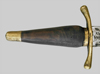    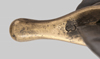 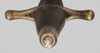 |
Plug Bayonet |
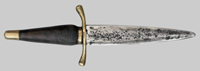
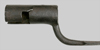
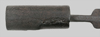
Plug bayonet styled closely after the British military plug bayonet of the late 17th Century, used for "Other Ranks" (i.e., enlisted men). However, the markings are not typical of British military plug bayonets, so it is unclear who made and used this particular bayonet. This example is possibly an old reproduction.
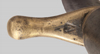
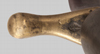
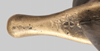
The markings on this example are on the crosspiece, rather than the blade, as is typically encountered on regulation British military plug bayonets. The grip is either walnut or blackened oak. British bayonets had a brass finial on the end of the pommel. This one has an iron washer. However, this could have been a repair, after the finial was broken or damaged. Surviving military plug bayonets for use by ordinary soldiers are very scarce. Because of this, I will probably never be able to precisely identify or date this piece. |
7.125 |
181 | 12.125 |
308 | n/a |
Crosspiece (side): "F" and "4" (modern marks)
Crosspiece (front): cross and "3" (period marks) Crosspiece (back): cross or sword and "V" (period marks) |
|
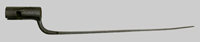 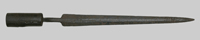     |
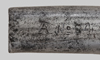
Long Shank Dutch/Liege Socket Bayonet | Socket bayonet for use with an .80 caliber flintlock musket.
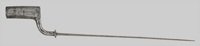
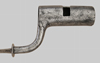
The long shank “Dutch/Liège” socket bayonet was among the early socket bayonet patterns to be widely exported. These were made by the Liège arms trade. This was before the formation of Belgium, when the Prince-Bishopric of Liège (Principality of Liège) was part of the Holy Roman Empire. The Dutch were leading arms exporters during the 17th and 18th Centuries. As a consequence, the term “Dutch” was loosely applied to arms exported by the Dutch, most of which were made elsewhere (esp. Liège and the German States). I include these under Britain, because they came to North America as a consequence of Britain’s rivalry with France that led to the French and Indian War (Seven Years’ War) of 1754–63. Older arms such as these were used to equip provincial troops of the British American Colonies. In 1715, at the end of the War of Spanish Succession (Queen Anne's War), Britain purchased 20,000 Dutch muskets and flat-bladed bayonets to replenish depleted Army stores until British production could make up for wartime losses. In his book, The Socket Bayonet in the British Army 1687–1783, author-researcher Erik Goldstein, illustrates a nearly identical bayonet, marked in the same way as this example, as the type believed purchased by Britain in 1715. This example likely dates from ca. 1725. The socket is formed by an overlapping weld at the top. The blade is of a flattened hexagonal cross-section, with long shank and a square shoulder with no guard. This example has a two-step I–mortise, indicating that it is the earliest of its type. Most had a third step added during their service life to create a L–mortise, however, this example remains unmodified. The bayonet is probably made of iron, which may account for its acquiring a slight bend near the point. The socket length is 2.9375 in. (75 mm.); the blade width is 1.125 in. (29 mm.). |
12.00 | 305 | 16.50 | 419 | 1.00 | 25.4 | Socket: "O" over "No ?063" |
     |
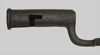
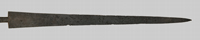
Short Shank Dutch/Liege Socket Bayonet | Socket bayonet for use with a .75–.80 caliber flintlock musket.
Britain purchased 36,000 stands of “Dutch arms” in 1740-41 and a further 10,000 in 1745 to supply its colonial forces. Some of these weapons were sent to North America, seeing service during the French and Indian War (Seven Years’ War) of 1754–63. These also saw service in North America during the Revolutionary War, supplied to Hessian mercenaries hired by the British to fight the Continental Army. Examples have been excavated at many North American sites associated with these two conflicts. The refined socket lacks the crude lap weld of the long shank bayonet pictured above. It features a shorter, stronger shank and conspicuous oval guard at the blade shoulder. The blade is of a flattened hexagonal cross-section. This example has a two-step I–mortise, indicating that it is among the earlier of its type. Most had a third step added during their service life to create a L–mortise, however, this example remains unmodified. The socket length is 2.875 in. (73 mm.). The blade width is 1.00 in. (25 mm.). |
12.00 | 305 | 16.50 | 419 | .950 | 24.1 | Socket: "A No. 84" |
        |
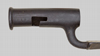
Early Land Pattern Brown Bess | Socket bayonet for use with the .75 caliber Long Land Pattern Brown Bess flintlock musket.
The Land Pattern musket was introduced in 1722. Both the musket and its bayonet evolved over time, until superseded by the India Pattern at the close of the 18th Century. This example is of the Pattern 1727, likely dating from ca. 1730. Distinguishing characteristics include: a wide blade, with a concave face and prominent circular guard. Elbow is flush with the socket front and extends well-forward of the socket. The socket-elbow join features a rounded shield. This example has a rack marking, which is indicative of a Board of Ordnance piece. There were two suppliers of socket bayonets to the Board of Ordnance during the period this example was made: Thomas Hollier, Armoury Mills, Lewisham, and William Huggins of Birmingham (1727-30 only). Blade width is 1.375 (35 mm.); Muzzle Length 2.00 in. (51 mm.). The 4.00 in. (102 mm. ) socket is cut for a top stud. |
16.75 | 425 | 20.75 | 527 | .920 | 23.4 | Ricasso: "P"
Socket: "2/95" |
     |
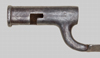
Land Pattern Brown Bess | Socket bayonet for use with the .75 caliber Short Land Pattern Brown Bess flintlock musket.
This example is of the Pattern 1768 bayonet, made by Samuel & George Harvey of Birmingham 1779–81. Per Graham Priest, the Harveys made 16,330 in '79, 13,751 in '80 & 2,600 in '81. This example has a socket marking indicating that it was used by light infantry. During this time, British Regiments of Foot (i.e., infantry), each had one company of light infantry. It likely came over to America during the Revolutionary War. Blade is 1.35 in. (34 mm.) wide. The 3.950 in. (100 mm.) socket is cut for a top stud. |
16.25 | 413 | 20.187 | 513 | .925 | 23.5 | Ricasso: Crown-6, "Harvey", "2", and "M"
Socket: "L I" over "10" |
    |
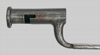
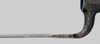
India Pattern Brown Bess | Socket bayonet for use with the .75 caliber India Pattern Brown Bess flintlock musket.
The India Pattern musket and bayonet were introduced in 1795, making the India Pattern Brown Bess Britain's primary infantry arm during the Napoleonic Wars. As a consequence, the India Pattern bayonet was manufactured in huge numbers, some 3 million having been produced by 1815. This example was made by Henry Osborn, who produced India Pattern bayonets from 1796–1808, when he entered into partnership with John Gunby. Osborn's name was stamped in a distinctive copperplate script. The socket bears a rack number, commonly seen on bayonets of this period. The blade is 1.2 in. (30 mm.) wide. The 4.00 in. (102 mm.) socket is cut for a top stud. |
17.50 | 445 | 21.50 | 546 | .925 | 23.5 | Ricasso: "0" over "Osborn" over "X" and Crown-24
Socket: "K" over "64" |
      |
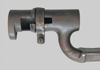
Volunteer Sword/Socket | Socket bayonet for use with a .65 caliber flintlock musket.
These were made outside of the British Ordnance System for private sale. This example is identical to bayonet B58 documented in Skennerton's book, British and Commonwealth Bayonets. According to Skennerton, these date from 1775–1800. The blade is single edged with a shallow fuller on both sides. Blade is 1.25 in (32 mm.) wide. The horizontal blade orientation positions the blade edge down when fixed. The 3.625 in. (92 mm.) socket is cut for a top stud. This design was not widely used, so these don't turn up all that often. |
19.875 | 505 | 23.50 | 597 | .855 | 21.7 | Ricasso: "CC"
Collar: "2" "X" and two sets of two parallel hash marks |
    |
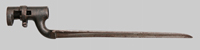
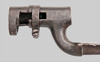
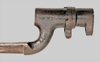
Pattern 1853 | Socket bayonet for use with the Pattern 1853 Enfield Rifle-Musket.
This example has no British government markings, indicating that it was likely imported to the USA during the American Civil War. According to British socket bayonet authority Graham Priest, the “J•R” marking indicates that the bayonet was likely made in Liege, Belgium. The other ricasso marking may be an incomplete CHAVASSE. There was a retailer, Horace Chavasse & Co., at Alma street, Aston Newton (near Birmingham, England) 1860–1868. Chavasse has been documented as also having marked and exported P1856 sword bayonets. The socket length is 3.00 in. (76 mm.). |
17.25 | 438 | 20.25 | 514 | .787 | 20.0 | Ricasso: "P (dot) B" and “CHAVAS”
Socket (rear edge): 2 punch marks and 7 notches |
     |
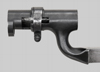
Junior Enfield | This example is an approximately half-scale copy of the British Pattern 1853 socket bayonet. This comparison image shows this example photographed alongside the Pattern 1853 bayonet above.
The socket is blackened and the blade is in the white. The bridge has a cutout shaped to go over a front sight. The socket length is 2.25 in. (57 mm.). It is very sturdily constructed, with faithful attention to detail. Too dangerous to be a toy. These bayonets are scarce and little is known of their origin. Research by Shawn Gibson (http://www.bayonetconnection.com) published in the Society of American Bayonet Collectors (SABC) Journal, Volume 42, Winter 2002, provided evidence in the form of a ca. 1870-90 albumen photograph taken by a New York photographer that these bayonets were used in the USA during the late 19th Century. |
8.125 | 206 | 10.375 | 264 | .535 | 13.6 | Elbow: "29" |
   |
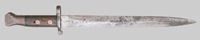
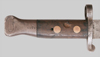
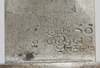
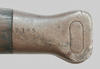
Pattern 1876 | Socket bayonet for use with the .577/450 caliber Martini-Henry rifle.
This example was made at RSAF Enfield in April 1888. The socket and elbow are blued. The blade is polished bright. The socket length is 3.00 in. (76 mm.). |
22.25 | 565 | 25.25 | 641 | .710 | 18.0 | Ricasso: "433" (lined-thru); WD-Broad Arrow; Crown over "E" over "27"; "4/88" |
     |
Pattern 1888 | Knife bayonet for use with the .303 caliber M1888 Lee-Metford and Long Lee-Enfield rifles.
There were four distinct P1888 subtypes: —Mk. I 1st type had grips secured by one large and two small brass rivets. The P1888 was produced at the Royal Small Arms Factory, Enfield (RSAF Enfield) and by government contractors: —Robert Mole & Sons Commercial producers also made P1888 bayonets for purchase by volunteers. These sometimes differ in the details from the government pattern. This example is a P1888 Mk. I 2nd Type made in February 1899 at RSAF Enfield. |
11.875 | 302 | 16.625 | 422 | .655 | 16.6 | Ricasso (L. Side): Crown over 2 99". Various reissue dates "02, 03, and 03" and inspector's stamps.
Ricasso (R. Side): broad arrow proofmark over "EFD" Enfield inspector's mark (crown over 58 over E) and "X" bending test mark. Pommel: "2165" |
     |
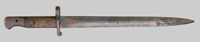
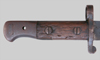
Pattern 1895 | Socket bayonet for use on the .303 caliber M1895 Martini-Enfield rifle. The Pattern 1895 bayonets were altered Pattern 1876 bayonets, originally made for the caliber .577–450 Martini-Henry rifle.
This example was converted at RSAF Enfield in January 1900. This example saw service in the Middle East, probably Egypt. According to Skennerton, Pattern 1895 bayonet conversions were only done at Enfield, with 86,234 conversions done between 1895–1902. Alterations include compressing the socket to the smaller diameter, filling the original mortise, and cutting a new mortise 90 degrees from the original to allow the bayonet to hang underneath the barrel when fixed. A filled portion of the original P1876 mortise is visible under bright light. The socket length is 3.00 in. (76 mm.). The RSAF Enfield modification is a more sohisticated approach vs. the Pattern 1876 bayonets modified at the Citadel Arsenal in Cairo for use with the Martini-Enfield. The Citadel modifications include bushing the socket to reduce diameter and cutting away the bridge to clear the Martini-Enfield’s tall front sight. This modification did not alter the bayonet's original mortise, so the bayonet continued to fix at the right side of the barrel. |
21.50 | 546 | 25.125 | 638 | .650 | 16.5 | Ricasso: broad arrow proofmark and "1 00" and Enfield inspector and bending test proof marks.
Blade (Right): "479" in Arabic Blade (Left): "184" in Arabic lined through and British inspector mark |
    |
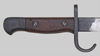
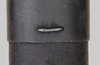
Pattern 1903 | Knife bayonet for use with the .303 caliber Short, Magazine, Lee-Enfield No. I Mk. III (SMLE) rifle. This rifle was the British mainstay during World War I. The SMLE also saw extensive use by Commonwealth countries during the Second World War.
The Pattern 1903 design combined the Pattern 1888 blade and crosspiece, with a new pommel design. The P1903 had a short service life, as the blade length was determined insufficient when combined with the shorter rifle. The P1903 was produced at the Royal Small Arms Factory, Enfield (RSAF Enfield) and by government contractors: —Robert Mole & Sons The P1903 was produced for British use from 1903–1907, at which time the P1907 was adopted. New production will carry dates in the aforementioned period. Many earlier P1888 bayonets were also rehilted with the P1903 pommel. These will have earlier dates. Commercial production for colonial use may have continued beyond this period. (A commercial example shown on the Afghanistan page.) This example was made in October 1903 by the Wilkinson Sword Co. of London and appears to have underwent repair at the RSAF Enfield in 1916. |
11.75 | 298 | 16.50 | 419 | .660 | 16.6 | Ricasso (left): "10 03"
Ricasso (right): broad arrow, bend test mark, Enfield proofmarks, "16", and "Wilkinson, Lond." |
          |
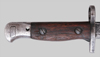
Pattern 1907 Hooked Quillon | Sword bayonet for use with the .303 caliber Short, Magazine, Lee-Enfield No. I Mk. III (SMLE) rifle.
As shown in this comparison image, the Pattern 1907 bayonet was modeled closely after the Japanese Type 30 bayonet, which Britain had obtained in 1906 for trials. British production began in 1908. As originally produced, the Pattern 1907 bayonet had a hooked lower quillon as did the Type 30. In service, the lower quillon was unpopular. In Britain, the lower quillon was officially deleted in 1913. The lower quillon was removed from the majority of early bayonets during refurbishment. Millions of Pattern 1907 bayonets were produced for Britain, Australia, and India. British makers of the Pattern 1907 with hooked lower quillon include the Royal Small Arms Factory, Enfield; and the following British government contractors: —James A. Chapman This example was made in December 1910 at the Royal Small Arms Factory, Enfield. It retains the hooked lower quillon. It was sold from British service and made its way to Australia, where it served with the Queensland Police. The scabbard with this example is Australian, made in 1943. |
17.00 | 432 | 21.875 | 556 | .655 | 16.6 | Ricasso (left): Crown over "1907" over "12 10" over "EFD"
Ricasso (right): Broad Arrow and "X" (Bend Test Mark) and Enfield viewer's marks. Pommel (left): Sold-from-Service mark Pommel (right) "Q (arrow) P" over "565" Scabbard (topmount): "OA" Scabbard (endmount): "OA" Scabbard (body): "Mangrovite 43" |
      |
Pattern 1907 | More commonly encountered Pattern 1907 without the hooked lower quillon.
British makers include the Royal Small Arms Factory, Enfield; and the following British government contractors: —James A. Chapman This example was made in December 1918 by Sanderson Bros. & Newbould Ltd. of Sheffield. The scabbard pictured is a British No. I Mk. II scabbard with the teardrop frog stud. Some scabbard producers adopted a round frog stud, which was approved as an option in 1915. |
17.00 | 432 | 21.75 | 552 | .655 | 16.6 | Ricasso: Crown over "GR" over "1907" over "12 18" over "Sanderson" and Broad Arrow
Scabbard (endmount): British viewer's (inspector's) mark |
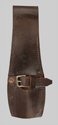 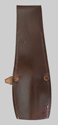 |
Belt Frog | Brown leather belt frog for use with the Pattern 1907 bayonet.
Designated the Brown Leather Sword Bayonet Frog Mark II, this frog was adopted in 1912 for use at the Royal Military College at Sandhurst and the Royal Military Academy at Woolrich. The frog is constructed of brown leather, with a brass buckle and copper rivets. This pattern remained in use until 1969, when it was replaced by a white plastic frog. The frog measures 9.25 in. (235 mm.) long by 3.00 in. (76 mm.) wide. |
n/a | n/a | n/a | None. | |||
| Back | Next | ||||||||
| Return to Bayonet Identification Guide Index | |||||||||
| © Ralph E. Cobb 2009 All Rights Reserved | Top | ||||||||