| Pictures (click to enlarge) |
Type | Description | Blade Length |
Overall Length |
Muzzle |
Markings | |||
| in. | mm. | in. | mm. | in. | mm. | ||||
 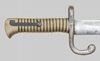 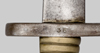  |
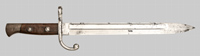
Comblain Cadet Yataghan |
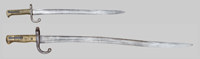
A diminutive yataghan sword bayonet for a scaled-down rifle, as would be used in a military boarding school for young boys. Very well made, with good attention to detail. Definitely not a toy.
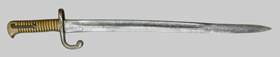
These bayonets likely date from the 1880s. The picture at lower left shows this bayonet next to a French M1866 bayonet to provide a size comparison. "Yataghan" is derived from the Turkish word for "one who lays down" to describe the downward-sweeping double-curve blade profile. The double-curve added strength and rigidity, while keeping the hilt and point in alignment for thrusting efficiency. When I found this piece, noted bayonet collector, Dr. Jim Maddox (author of Collecting Bayonets), wrote to me, indicating: |
13.375 |
340 | 17.00 |
432 | .610 |
15.5 | Crosspiece: "36" |
|
Click on the image to view information and additional images on the Uruguay Page. |
M1894 | Knife bayonet for use with Fabrique Nacionale (FN) 7 mm. Spanish Mauser (le Mauser espagnol) rifles made for export, to Uruguay and Brazil. Brazil designated the rifle M1894.
Research published in 2016 by Anthony Vanderlinden in his book, FN Mauser Rifles, infers that this bayonet may have been made for Brazil. If so, it is unclear how to distinguish between Brazilian and Uruguayan examples of this bayonet. |
11.625 | 295 | 16.50 | 419 | .615 | 15.6 |
|
 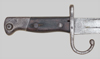   |
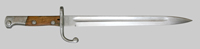
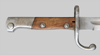
M1904 Yataghan | Sword bayonet for use with the 7 mm. M1904 Mauser-Vergueiro rifle.
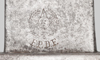
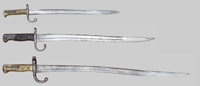
M1904 bayonets have a shorter hilt than M1908 and later Mauser bayonets, so only fit on M1904 Mauser rifles. The M1904 was adopted by Brazil for use by the paramilitary police force in the (then) national capitol of Rio De Janeiro. The ricasso marking is the Brazilian national crest, over "F.P.D.F." (Força Pública Distrito Federal). It is believed that DWM built around 5,000 M1904 rifles chambered in 7 mm. ca. 1907 using parts left over from the Portuguese contract. The maker of the bayonet is not known. No actual production records have been found. The Brazilian M1904 sword bayonet is historically-significant in two ways: The comparison image at left illustrates how the M1904 bayonet's scale is mid-way between the M1880 Comblain (or French M1866) bayonet and the Cadet Comblain Yataghan. The M1904's overall length equals the M1880 Comblain's blade length, while the Cadet Comblain's overall length equals the M1904's blade length. |
17.562 | 446 | 22.375 | 568 | .615 | 15.6 | Ricasso: Brazilian National Crest over "F.P.D.F." |
     |
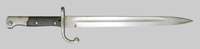
M1908 | Knife bayonet for use with the 7 mm. M1908 Mauser rifle produced for Brazil by DWM in Germany. The M1908 was closely patterned on the Gewehr 98 rifle used by Germany.
These bayonets were made from 1908–1914 by several German blade makers. This example was made by Simson & Co. of Suhl, Germany. The firm of Alex Coppel also made bayonets. The German-made scabbard has a leather body with brass mounts. |
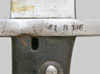
11.75 | 298 | 17.00 | 432 | .620 | 15.7 | Ricasso: "Simson & Co." over "Suhl"
Blade: "RB" inside an oval Crosspiece: "7315" Scabbard: "7682" on frog stud |
    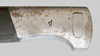  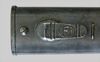 |
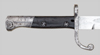
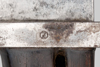
Another M1908, made by Weyersberg Kirschbaum & Co. of Solingen, Germany.
"FI" is an abbreviation for Fabrica de Itajuba, the Brazilian state arms factory. This identifies the scabbard as a Brazilian-made replacement scabbard. These later scabbards have a leather body with blued steel mounts. |
11.75 | 298 | 17.00 | 432 | .620 | 15.7 | Ricasso: "W. K. & Cie" over "Solingen"
Blade: Teardrop over "β" (beta) inspection mark Pommel: "β" (beta) inspection mark Crosspiece: "1816" Scabbard: "F I" inside an oval on frog stud |
|
    |
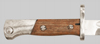
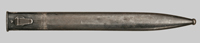
M1908/34 | Sword bayonet for use with the 7 mm. Mauser M1908/34 Police Carbine (Czech vz. 12/33). This bayonet could also be used with the .30-06 caliber M1908/34 and M954 Short Rifles produced at the State arms factory, Fabrica de Itajuba.
Brazil obtained 100,500 7 mm. M1908/34 Police Carbines with bayonets from the Czechoslovak Republic in 1937. The carbines and bayonets were made at Československá zbrojovka a.s., Brno. There is a tiny circle-Z export mark on the crosspiece. Some of these carbines were subsequently rebarreled to .30-06 caliber at Fabrica de Itajuba. Construction is similar to the M1908, except for the longer blade and the grip scales are secured by screw bolts. This scabbard is unusual, in that the brass mounts are salvaged from an earlier M1908 scabbard, rather than the blued steel mounts normally found on M1908/34 scabbards. |
14.875 | 378 | 20.00 | 508 | .615 | 15.6 | Crosspiece (right):"1452" over "C" and "β" (beta) inspection mark
Crosspiece (left):"Z" inside a circle Pommel (top): "β" (beta) inspection mark Scabbard (topmount): "3002" and "4" Scabbard (frog stud): "F" and "1" (remains of old M1908 serial number) |
     |
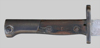
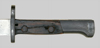
M1935 | Knife bayonet for use with the 7 mm. Mauser M1935 rifle.
The bayonet and scabbard are similar to the Belgian M1924 Mauser Export bayonet, which was widely used in South America during the 1930s. The grip scales are secured with screwbolts vs. the rivets found on many South American Mauser bayonets. The M1935 rifle was closely patterned after the M1908 rifle. It is believed approximately 8,000 were produced by Mauser for Brazil 1935-38. Serial no. 7910 was the highest observed until a Canadian collector recently reported to me that he has rifle serial no. 7984. Produced under a commercial contract, the rifles carry the famous Mauser “Banner” trademark. These rifles and bayonets are uncommon today. The producer of the bayonet is not known. Documentation on one lot of 1,000 rifles indicates their being supplied with bayonet, the blade being 300 mm. long (same length as this example). However, evidence suggests that bayonets were supplied with the majority of M1935 rifle production. |
11.75 | 298 | 16.875 | 429 | .620 | 15.7 | Crosspiece (left): "576" |
      |
M1924/49 Short | Knife bayonet for use on the caliber .30-06 Fabrique Nationale (FN) Model 1949 self-loading rifle.
Brazil received 11,000 Model 1949 production rifles from 1954-56. This was the final production order for the Model 1949 rifle. Model 1949 rifles were used by the Brazilian Navy and Marines. Brazil opted for a modification of the M1924 Short Mauser export bayonet. The M1924/49 Short bayonet is identical to the Mauser version, except for the much larger muzzle ring. Research published in 2019 by Wayne Johnson in the revised and expanded second edition of his book, The FN-49, documented that Brazil was the only Model 1949 purchaser that adopted the M1924/49 Short bayonet. Indonesia and Venezuela used the M1924/49 Long sword bayonet with their Model 1949 rifles. Argentina, Belgium, Colombia, (Belgian) Congo, Egypt, and Luxembourg all used the Model 1949 knife bayonet. Colombia also modified M1912 Mauser bayonets for use on the FN Model 1949. |
11.75 | 298 | 16.875 | 429 | .710 | 18.0 | Pommel: illegible serial number |
  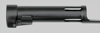 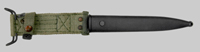  |
FAL Type C | Socket bayonet introduced in the 1960s for the 7.62 mm. NATO caliber FN–FAL selective-fire rifles that incorporated the 22 mm. NATO-spec flash hider.
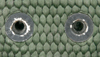
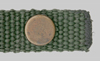
This example has the M1965 spring catch and a black paint finish. The scabbard is plastic, with an integral cotton web belt hanger. The snap fastener on the belt frog is marked "Eberle." Eberle S.A. is a Brazilian firm that manufactures, among other things, textile fasteners. The identification of this bayonet as having been made by IMBEL is based on the identification of the belt hanger's fasteners. IMBEL is an abbreviation for Industry Material Bélico do Brasil (Military Material Industry of Brasil), the State arms factory formerly known as Fabrica de Itajuba. |
6.75 | 165 | 11.375 | 289 | .890 | 22.6 | Snap (belt hanger): "Eberle" |
      |
SAR–48 (FAL Type C) |
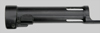
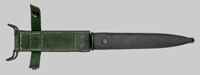
A commercial bayonet shipped with the Springfield Armory Inc. SAR–48 rifle. The SAR–48 rifles were semi-auto FAL rifles produced by IMBEL in Brazil for commercial sale in the USA by Springfield Armory Inc.
This example would have been produced in the 1980s. The bayonet is unmarked, with a black paint finish overall. The scabbard has a plastic body, with an integral nylon web belt frog. The throatpiece is positioned so the socket faces outward. The belt frog has the U.S. M1910-style wire belt hanger. Both the copper-plated glove fastener and rivets used on the belt hanger are marked "Eberle." The SAR–48 bayonet is unusual in being of late manufacture, but having the M1963 serrated spring catch. |
6.375 | 162 | 11.375 | 289 | .890 | 22.6 | Glove Fastener and Rivets (belt hanger): "Eberle" |
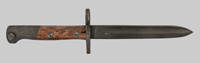 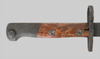   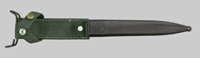 |
Mosquetão M968 | Knife bayonet for use with the Mosquetão 7,62mm Modelo 968 (Carbine 7.62 mm. Model M968).
The MQ M968 is a variant of the .30–06 caliber Mauser M954 rifle and is used by the Brazilian Army for basic training. It is unofficially referred to as the "Mosquefal" due to modifications that enable it to use the ammunition and rifle grenade accessories of the FAL assault rifle. The MQ M968 bayonet is a modification of earlier M1908 knife bayonets used with the 7 mm. Mauser M1908 rifle. The blade was cut down from 11.75 in. (298 mm.) to 6.50 in. (165 mm.). The original hooked crosspiece was replaced by a straight crosspiece with a much larger muzzle ring. All of the metal was bead-blasted and parkerized. The wood grip scales are secured by screw-bolts. The scabbard has a plastic body, with an integral nylon web belt frog. The belt frog has the U.S. M1910-style wire belt hanger. The hilt strap button is made of copper. The scabbard is patterned after those produced in Brazil for the FAL Type C bayonet. However, this scabbard was made especially for use with the MQ M968 bayonet. The MQ M968 scabbard has a rectangular throatpiece, instead of the semi-circular throatpiece used for the FAL Type C bayonet. |
6.50 | 165 | 11.625 | 295 | .890 | 22.6 | Crosspiece: "92812"
Snap (belt hanger): "Eberle" |
| Back | Next | ||||||||
| Return to Bayonet Identification Guide Index | |||||||||
| © Ralph E. Cobb 2010 All Rights Reserved | Top | ||||||||