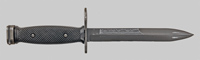
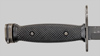
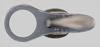
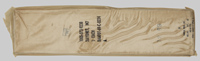
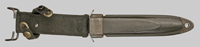
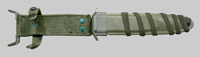
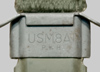
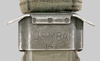
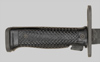
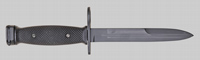
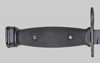
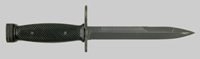
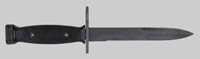
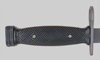
| USA | U.S. M5 and M5A1 Bayonets | The July 1950 commitment of U.S. troops to the Korean War provided impetus that led to adoption of the M5 bayonet. By February 1951, the Army had already identified the “military characteristics for a knife-type bayonet” for the caliber .30–06 U.S. M1 Garand rifle. By December, Springfield Armory was formally assigned responsibility for its development. Prototypes designated T10 were developed and tested. These had smooth plastic grips that fully-enclosed the pommel and included the characteristic steel stud that inserted into the M1 rifle's gas cylinder lock screw. In December 1952, Imperial Knife Co. owner, Michael Mirando, filed a patent for a bayonet design that represented a refinement of the T10 prototype. After further refinement of the Mirando design, the bayonet was designated M5 on July 10, 1953.
The M5 bayonet is noteworthy in that the parts are almost all stampings (including the blade). This substantially reduced production cost. Under Utica's 1953 M1 bayonet contract, the cost was $6.08 per bayonet. Under J & D Tool Co's. 1954 M5 contract, the cost was approximately $1.65 per bayonet. As discussed below, wartime pressures and supply shortages resulted in a chaotic changeover from procurement of the M1 bayonet to the M5, resulting in: —Concurrent procurement of M1 bayonets from Utica and M5 bayonets from Imperial; Field problems with the M5 bayonet cropped up quickly. In October 1954, the Chief of Army Field Forces, Gen. John E. Dahlquist, requested that the Ordnance Dept. suspend M5 bayonet production. This request was denied by Army Deputy Chief of Staff G-4 (Logistics), Gen. Williston B. Palmer (Gen. Palmer and his brother Charles, were the first pair of brothers to both achieve Army 4-star rank). Contrary to popular belief, the latch modification represented in the M5A1 bayonet was not developed in response to the M5 bayonet’s field issues. The latch modification was developed during design of the M6 bayonet for reasons solely applicable to the M14 rifle. The Army studied adapting the M6 latch to the M5 bayonet during 1955 at the Aberdeen Proving Ground in Maryland, designating the test bayonet M5E1. The modified latch purposely allowed the bayonet to move forward slightly during recoil, which caused partial withdrawal of the M5 mounting stud from the M1 rifle’s gas cylinder lock screw. There were concerns that the latch may bind and the bayonet fail to return home, leaving the M5 bayonet loose on its mount. A 25-page technical report entitled, A Test of the M5E1 Bayonet, was issued April 22, 1955. This did not result in adoption and further testing was done. In early 1956, another report, Technical Report SA-TR20-5000, Evaluation of Effect on Accuracy Performance of the caliber .30 M1 Rifle with the Bayonet, Knife, M5E1 Attached, is described as including the caveat that, “… the results are questionable because of the binding condition preventing the return of the bayonet to the original position following each shot.” While there may have still been some lingering concerns, the M5E1 test bayonet was officially adopted in April 1956. The improved latch was implemented immediately, mid-contract at J & D Tool Co. and in a new contract at Aerial Cutlery Co. The M5A1 designation had apparently not yet been finalized, resulting in the bayonets from these two contracts being marked M5-1. M5E1 was the Springfield Armory designation used during the development project, so the makers simply deleted the “E” as an expedient way to distinguish production bayonets with the improved latch from earlier M5 production. At least 11 M5/M5A1 prime contracts appear to have been let. U.S. government contractors and approximate years of production include: —Imperial Knife Co.: M5 1953–54; M5A1 1967–68, 1972–73, and 1976 At least 1.5 million M5/M5A1 bayonets appear to have been produced. Some M5 and M5A1 bayonets were marked with the Defense Acceptance Stamp (DAS), while many were not or may have had the DAS obliterated during service. The presence or absence of a DAS should not be criteria for determining whether a bayonet is U.S. Government Issue (USGI). More info on M5 bayonet production is available in the M5 and M5A1 Bayonet Contracts Summary. I’m indebted to Frank Trzaska for sharing his research material which helped further clarify the history of the M5/M5A1 bayonet. |
||||||||
| Pictures (click to enlarge) |
Manufacturer or Type | Description | Blade Length |
Overall Length |
Muzzle |
Markings | ||||
| in. | mm. | in. | mm. | in. | mm. | |||||
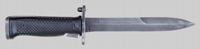 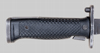 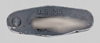  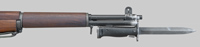 |
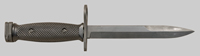
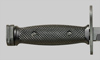
Imperial Knife Co. | Imperial Knife Co. of Providence, Rhode Island, appears to have been the first M5 bayonet contractor.
Despite not previously having made them, Imperial was awarded contract DA-19-058-ORD-7598 on June 11, 1953, for production of M1 bayonets. The contract was reported to have been in the amount $1,858,758. The M5 bayonet was adopted just one month later, so the government changed the contract’s design specifications to reflect production of the M5 bayonet and renegotiated the contract price. Initially, the renegotiated price was $4.80 per bayonet, but this was subsequently reduced to $4.00. The total quantity produced has not been documented, but must have been significant given the large number of examples encountered today. Imperial was also awarded three contracts for the M5A1 bayonet, in fiscal years 1967, 1973, and 1976. In addition to being the the first producer of the M5 bayonet, these contracts also made Imperial the last producer of the M5A1 bayonet. A prolific producer of bayonets and scabbards, Imperial Knife Co. changed its corporate name to Imperial Schrade Corp. in 1984. Imperial’s losing out in the M9 bayonet competition resulted in closure of the Providence, RI, plant in 1987. Imperial Schrade continued operations in Ellenville, NY, until its closure in 2004 after 100 years of operation. |
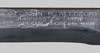
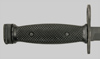
6.75 | 170 | 11.50 | 290 | n/a | Guard: "U.S. M5" and "Imperial" and Defense Acceptance Stamp (DAS) | ||
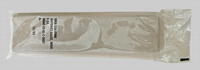 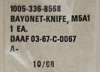 |
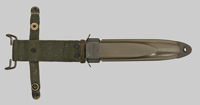
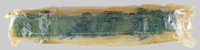
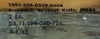
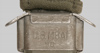
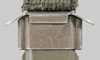
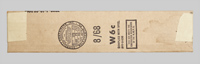
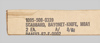
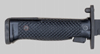
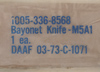
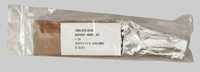
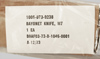
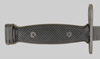
This example is from the first M5A1 bayonet contract awarded to Imperial Knife Co.
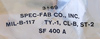
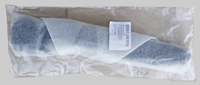
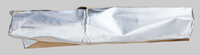
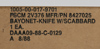
Contract DAAF-03-67-C-0067 was awarded in April 1967. This contract was not identified in Cunningham. This example was packaged in October 1968 and remains sealed in its original packaging. |
Wrapper:
"1005-336-8568 |
||||||||
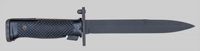     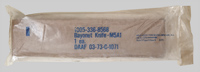  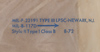 |
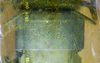
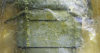
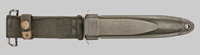
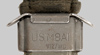
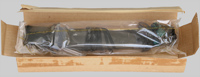
This example is from the second M5A1 bayonet contract awarded to Imperial Knife Co.
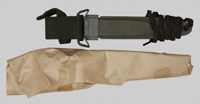
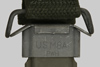
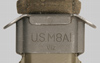
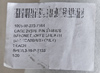
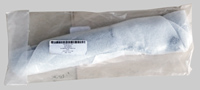
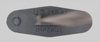
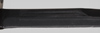
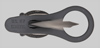
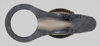
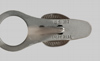
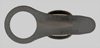
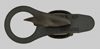
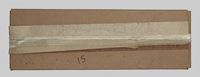
Contract DAAF-03-73-C-1071 was awarded in August 1972. The contract amount was $131,000, which suggests that the quantity produced was in the neighborhood of 40,000. This example was sealed in its original packaging. I discreetly opened the outer wrapper and unpacked the contents to enable examination of the runout on the bayonet blade. As shown in the image at left, the runout on the 1973 contract M5A1 bayonets are similar to the square runout found on Imperial 1973 contract M7 bayonets. |
Guard: "U.S. M5A1" and "Imperial" Label: "1005-336-8568 |
||||||||
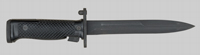 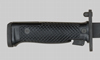 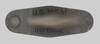 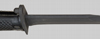  |
This example is from the third M5A1 bayonet contract awarded to Imperial Knife Co. These were the last M5A1 bayonets made for the government, some 33 years after Imperial began production of the first M5 bayonets.
Contract DAAF-03-76-C-6658 was awarded in June 1976 for $88,000. Cunningham’s book lists this as a M7 contract, however, it was actually for the M5A1. (Imperial was awarded another contract in June 1976 for the M7, DAAF-03-76-C-6646.) Cunningham indicates a quantity of 63,270, however, this is applicable to the M7 contract. Documentation of the true M5A1 quantity has not been found. Based on the contract amount, the quantity produced was probably in the neighborhood of 16,000. 1976 was the year when the federal government converted from a June 30–July 1 fiscal year to the present October 1–September 30 fiscal year. The available contract data from this transitional year is difficult to navigate, no doubt contributing to this confusion. The Ordnance Dept. revised their blade specifications in July 1974 to permit a curved or sloped runout (which had previously been accepted on a non-standard basis from J & D Tool Co. and Milpar). Imperial adopted a curved runout on their 1976 M5A1 contract. Imperial’s 1976-contract M5A1 bayonets also have a rounded blade spine, similar to what Milpar used on their late production. Most of the 1973 and 1976 contract M5A1 bayonets appear to have gone to foreign users of the M1 rifle. Examples from both of these contracts, still sealed in their packaging, were returned by Greece in 2010 and sold to collectors by the Civilian Marksmanship Program (CMP). |
Guard: "U.S. M5A!" and "Imperial" | ||||||||
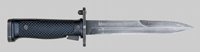 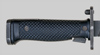  |
Aerial Cutlery Manufacturing Co. | Aerial Cutlery Manufacturing Co. of Marinette, Wisconsin, was awarded contract DA-19-058-ORD-7876 for production of 80,000 M5 bayonets and spare parts.
The Chicago Ordnance District strangely requested termination of Aerial’s contract just one week after awarding it. This became controversial, because Aerial’s M5 contract was for $2.25 per bayonet, while Imperial’s M5 contract was for $4.00 per bayonet. (Then) Congressman Gerald R. Ford questioned the propriety of the Army’s handling of the two contracts. The Chief of Ordnance, Maj. Gen. Emerson L. Cummings, rescinded termination on June 17, 1954, the same day he and Army G-4, Gen. Palmer, were scheduled to explain the situation to Wisconsin Congressman John W. Byrnes (in whose district Aerial was located). The assigned contract number corresponds to June 1954, although the original contract award likely occurred some months earlier. Aerial was subsequently awarded a contract for the M5A1 bayonet ca.1957. These bayonets are marked M5-1. The quantity produced under this contract is not known. Camillus Cutlery Co. supplied all of the blades used on Aerial’s Post-War bayonet production. Aerial’s business lines also included barbering and beauty supplies. As imported products made the cutlery business less profitable, Aerial successfully adapted by expanding their lines of barbering and beauty supplies, ceasing cutlery and bayonet production entirely by the early 1960s. Their corporate name was truncated to The Aerial Co., Inc. in 1982. Aerial continued operating independently until 2010, when it was acquired by Sally Beauty Supply for $70 million. |
Guard: "U.S. M5" and "Aerial" and Defense Acceptance Stamp (DAS) | |||||||
       |
Columbus Milpar & Manufacturing Co. | Columbus Milpar & Manufacturing Co. of Columbus, Ohio is believed to have been awarded three M5A1 bayonet contracts: in April 1962, August 1965, and June 1966.
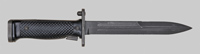
Milpar’s 1962 contract was for 190,000 M5A1 bayonets plus spare parts in the amount $369,508. The contracting board recommended rejecting Milpar’s bid due to their late M6 bayonet deliveries, and out of concern that Milpar lacked production capacity to produce expected quantities of M6 and M5A1 bayonets concurrently. Another bidder, Camillus Cutlery Co., also protested the proposed contract award to the General Accounting Office (GAO), citing Milpar’s late M6 deliveries. However, the GAO ruled against Camillus and the contracting board, ordering the M5A1 contract be awarded to Milpar. Milpar’s 1965 contract, DA-11-199-AMC-642, was in the amount $66,000. It is the only bayonet prime contract found that is documented as being placed for Foreign Military Sales. Available records do not explicitly state type, but has to be M5A1, as U.S. Government M14 and M16 rifles were not available to foreign users in 1965. Milpar’s 1966 M5A1 contract, DA-11-199-AMC-726, was in the amount $561,000. This contract became mired in Milpar’s post-1966 production woes and was not completed until late-1968 or early-1969. This M5A1 example exhibits the characteristic of late Milpar production (ca. 1968-69). From the outset, Milpar's bayonet production appears to have used a unique patented cold-stamping process to produce blades. Many Milpar M5A1 blades exhibit cold-stamping characteristics (see Milpar M6 bayonet below). By 1967, Milpar's blade production appears to have changed to a conventional surface-ground blade forming process similar to other contractors; and also began to exhibit a rounded spine. Ca. 1968, Milpar blades began to exhibit what was, in 1968–69, a non-standard curved (or sloped) runout. These features are found on Milpar M5A1, M6, and M7 bayonets. However, M5A1 bayonets are most common. These features have been erroneously thought to indicate commercial assembly by surplus dealers. However, the example pictured at left was taken from a sealed U.S. government package with an October 1968 packing date, substantiating that the curved (or sloped) runout was used on government contract production. Milpar had production output and quality issues from mid-1966 onwards that culminated in a government-ordered shutdown of bayonet production in January or February 1968. Whittaker Corporation's acquisition of Milpar was finalized almost concurrent to the government shutdown. Significant reworking of the production line appears to have occurred under Whittaker Corp. oversight, followed by Whittaker's replacement of Milpar's bayonet plant supervisors. It is likely that the curved runout was introduced at this point, although the specific production line changes have not been documented. Milpar's manufacturing variations were largely a consequence of their incoherent management of the bayonet production process. While some commercial assembly of bayonets using rejected and surplus Milpar parts did occur, manufacturing variations are not necessarily definitive evidence of commercial assembly or fakery. No Milpar M5A1 bayonet has been observed or reported as being marked with the Defense Acceptance Stamp (DAS). |
Guard: "U.S. M5" and "Milpar Col" and Defense Acceptance Stamp (DAS) | |||||||
   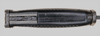 |
J & D Tool Co. | J & D Tool Co. of Stamford, Connecticut was awarded two M5 bayonet contracts: DA-19-058-ORD-7889 in December 1954 and DA-11-199-ORD-2 in 1956.
The 1954 contract amount was reported as $94,863. According to Cunningham, the 1954 contract was for 57,540 bayonets. The 1956 contract began as M5 bayonets, but production changed to the M5A1 mid-contract. These bayonets were marked M5-1. J & D Tool Co. appears to have encountered challenges in producing blades. Early J & D Tool M5 bayonets used blades supplied by Camillus Cutlery Co. J & D Tool Co's. own blades exhibit uneven workmanship, with some being quite crude. Camillus blades have the traditional 90-degree runout. J & D Tool Co. blades have a non-standard curved runout. Why the government accepted the curved runout is unknown. However, a curved runout again appeared on Milpar bayonets ca. 1968 after they had difficulty producing acceptable bayonets. The example pictured at left is an early J & D Tool Co. M5. It was made using a Camillus blade, which retains the original factory edge. It also has the “fat” grips that were only used in early M5 production. As is typical with J & D Tool Co. bayonets, the DAS is lightly struck. J & D Tool Co. was a family business that manufactured tools, dies, letter opener machines, and rifle components for the U.S. Government. The company was formed in 1947 and operated until 1963. At their peak, J & D Tool Co. reportedly employed 90 workers. The initials J & D were once thought to represent Jones and Dickinson. J & D were the initials of two of the company’s three founders, siblings: John, Dominick, and Theresa Spera (married name, Pittaro). However, the longer form was not used in the company name, which was simply J & D Tool Co. |
Guard: "U.S. M5" and "J & D Tool Co" and Defense Acceptance Stamp (DAS) | |||||||
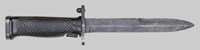 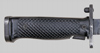 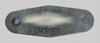 |
Utica Cutlery Co. | How Utica Cutlery Co. of Utica, New York came to produce M5 bayonets is not entirely clear.
Utica was awarded contract DA-19-058-ORD-7440 in March 1953 for 75,000 M1 bayonets. Ordnance Dept records show that the contract was completed in December 1953 without overrun or underrun; and, a subsequent overrun of 2,549 M1 bayonets was accepted in April 1954 (without any mention of Utica producing M5 bayonets under the contract). However, an April 1954 Ordnance Dept. memorandum references a shipping order that includes 10,000 M5 bayonets from Utica, showing that Utica was actively engaged in producing M5 bayonets at this time. No evidence of a separate Utica M5 prime contract has been found. An additional possibility is that Imperial could have subcontracted assembly of some M5 bayonets to Utica, as a way of increasing deliveries. As it stands, we still don’t know by what means Utica came to manufacture M5 bayonets. This example has the early “fat” grips. However, some Utica M5s are found with a unique grip whose checkering extends all the way to the mortise. This grip seems unique only to some portion of Utica’s M5 production. Utica M5 bayonets are also unique in being marked with the Ordnance Dept. Shell-and-Flame. The deadline for replacement of the shell-and flame with the Defense Acceptance Stamp (DAS) was July 1, 1953. This oddity just adds to the mystery around procurement of Utica’s M5 bayonets. The quantity produced by Utica is also not known with certainty. In 2012, Surplus dealer, Bill Ricca, indicated that he had seen a publication that covered Utica's production and it indicated that 28,000 Utica M5's were produced. In any case, Utica M5 bayonets are scarce. Although Utica remains in business today, the M5 bayonets produced in 1954 were the last bayonets they produced. |
Guard: "U.S. M5" and "Utica" and Ordnance Dept. Shell-and-Flame | |||||||
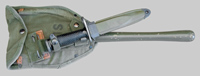 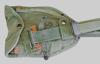 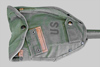 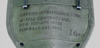 |
M1956 Entrenching Tool Bayonet Carrier | Olive green web carrier for attaching the entrenching tool to web equipment. Has provision for attaching the M8A1 scabbard to allow carrying of the bayonet as well.
Carrier measures 10.50 in. (267 mm.) long by 7.375 in. (187 mm.) wide. This example was made in 1967 and is shown here with the US M6 bayonet. |
Front: "US" Reverse: "Carrier Intrenching Tool |
|||||||
| Denmark | 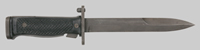 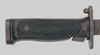  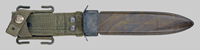  |
m/62 | Bayonet-knife used as a field knife by Denmark. Although it would mount to the M1 Garand rifle, it was typically issued as a field knife, to soldiers not armed with the M1 rifle.
The m/62 is a copy of the U.S. M5A1 bayonet, adopted by Denmark in 1962. Two production variants exist. both made in Germany. Early production is believed to have been produced by E & F Hörster. These had a peened pommel, as shown in the image at left. Later production had a smooth pommel and were marked "HMAK." These are believed to have been produced by Carl Eickhorn Waffenfabrik. According to Danish sources, 32,300 m/62 bayonets were procured. The scabbard is a copy of the US M8A1, employing a British-style belt fastener. The scabbard body is made of Durofol, a laminated wood developed in Germany during the Second World War. It is made by impregnating beech veneers of 0.2 to 0.3 mm. thickness with 25 to 35 percent of a water-soluble phenolic resin cured under both high pressure and temperature. Post-War, Durofol KG, J. Brangs & Co. of Solingen became the exclusive manufacturer, which later became Durofol Presswerk GmbH. HTK is an abbreviation of Hærens Tekniske Korps (Army Technical Corps). This marking was used 1960–69. |
Pommel: Crown over "HTK" over "M/62"
Scabbard: Crown over "HTK" |
||||||
| Haiti |      |
U.S. M5A1 | Bayonet-knife for use on the caliber .30–06 M1 Garand rifle.
Unlike the more typical German-made Haitian M5A1 bayonets, this U.S. M5A1 bayonet with a Haitian serial number has seen considerable use. I recently acquired this piece. However, at the 2022 Society of American Bayonet Collectors meeting in Baltimore, well-known bayonet dealer Dennis Ottobre had given me images of a Haitian-marked U.S. M5A1 that he had sold ca. 2012 for my research. Comparing to the old images, it is clearly the same bayonet, so may be the only known example of a Haitian-marked U.S. M5A1 to have surfaced. Haiti is documented to have received 2,799 M1 rifles from the U.S.: 799 prior to 1963 via the U.S. Military Assistance Program (MAP) and 2,000 as part of a 1973 Foreign Military Sales (FMS) purchase. In 1973, Haiti also appears to have obtained an unspecified quantity of M1 rifles from Jordan through a commercial arms purchase. Some of Haiti’s M1 Garand rifles were seized by U.S. Forces during Operation Uphold Democracy in 1994–95, returned to the U.S. and given to the Civilian Marksmanship Program (CMP). CMP put them into their regular inventory and sold them to collectors who never knew the history of the rifle they received. This bayonet was made by Columbus Milpar & Manufacturing Co. ca.1968, so probably came with or alongside one of Haiti's 1973 M1 rifle purchases and was subsequently marked by them. It likely came back to the U.S. as a souvenir from Operation Uphold Democracy, which saw 20,000 U.S. troops deploy to Haiti and as discussed above, where M1 rifles were confiscated by U.S. forces. The scabbard is a ca. 1965–68 Pennsylvania Working Home for the Blind U.S. M8A1 scabbard missing the steel tip protector. The web strap assembly is a well-made, but not U.S.G.I. replacement. |
Blade: "2851-F"
Guard: U.S. M5A1 and MILPAR COL Scabbard: "U.S. M8A1" and "PWH" |
||||||
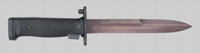 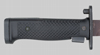  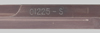 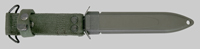  |
M5A1 | This bayonet was produced by A. Eickhorn-Solingen (AES), in West Germany, for the government of Jean-Claude "Baby Doc" Duvalier of Haiti. It is believed that the bayonets were produced in 1985–86, but deliveries had not began by February 1986, when Duvalier went into exile. AES stopped production and sold what they had already produced on the commercial market.
These bayonets are very well made, exhibiting a level of fit and finish not found on U.S.-made examples. The blade has the characteristic AES plum-colored finish and the unique Haitian serial number. The grip is secured with Phillips-head screws. The scabbard differs from the U.S. M8A1 in that the lower is made of molded plastic without a metal tip protector. Note how large the tie hole in the tip is, compared to a U.S.-made M8A1 scabbard.
|
Blade: "01225-S"
Guard: "US M5A1" Scabbard: "U.S. M8A1" |
|||||||
| South Korea | 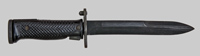   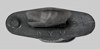 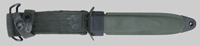 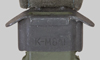 |
K-M5A1 | Bayonet-knife for use on the caliber .30–06 M1 Garand rifle.
Military Assistance Program (MAP) records document that the U.S. provided 348,814 M1 rifles; a total of 577 M1C and M1D sniper rifles; and, 41,176 M5A1 bayonets to Korea between 1951 and 1972. A clone of the U.S. M5A1 bayonet, but not as well made. The grip scales on these are much thinner plastic than on the U.S. version and more prone to cracking. The scabbard is a clone of the USA M8A1. |
Guard: "K–M5A1" and "DYW" and 'figure–8' symbol
Scabbard: "K–M8A1" and winged anchor & star logo on reverse. |
||||||
| Turkey | 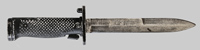 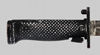  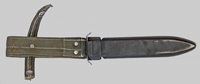 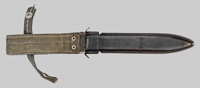    |
Copy of U.S. M5 Bayonet | Knife bayonet for use with the caliber .30–06 M1 Garand rifle.
This bayonet and scabbard are crude copies of the U.S. M5 bayonet and M8A1 scabbard. They are entirely of Turkish manufacture. The bayonet's grips are made of cast aluminum, painted black. The scabbard body is made of sheet steel. The belt hanger on this example is made of canvas, folded and stitched. These were made by M.K.E. in Ankara (Makina ve Kimya Endustrsi Kurumu, in English, Mechanical and Chemical Industry Corp.). MAP records document that the U.S. provided 314,432 M1 rifles to Turkey between 1951 and 1972. MAP records do not show shipment of any bayonets to Turkey, which explains the need to produce indigenous bayonets for the M1. These bayonets first surfaced ca. 2014 in very small numbers. Another quantity surfaced in 2017, about the time Turkey returned 13,000 M1 rifles to the U.S. Government. |
Pommel: "4" and "291"
Scabbard Body (front): Turkish Crescent and MKE trademark. Scabbard Body (reverse): Turkish Crescent and MKE trademark. Belt Hanger (inside dome fastener): "Tiger" (2) stars and 3 letters |
||||||
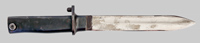 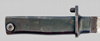 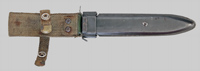 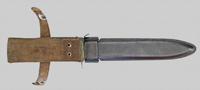   |
Ersatz M5 Bayonet | Knife bayonet for use with the caliber .30–06 M1 Garand rifle.
Crudely constructed of a pressed steel hilt mated with a recycled blade from an earlier Mauser bayonet. It is unclear whether the hilt is new-made or both the hilt and blade are from an earlier bayonet, with only the crosspiece being new. The scabbard construction differs from the MKE scabbard above, being a more refined copy of the U.S. M8A1, with a belt hanger made of webbing. As shown in this comparison image, the sheet steel body is of substantially better construction than the MKE example above. These bayonets first surfaced in 2017, about the time Turkey returned 13,000 M1 rifles to the U.S. Government. |
None. | |||||||
| USA | U.S. M6 Bayonets | Bayonet-knife for use on the 7.62 mm. NATO caliber U.S. M14 selective-fire rifle.
The search for a replacement for the M1 rifle was already underway when the Second World War ended. In December 1951, when Chief of Ordnance, Maj. Gen. Elbert L. Ford, assigned Springfield Armory responsibility for developing what would become the M5 bayonet, he noted that the military characteristics specified “are equally applicable to bayonets for use with developmental caliber .30 lightweight rifles” (what would become the M14). This explains the similarities between the M5A1 and M6 bayonets. Prototypes designated T12 were developed. The T12 bayonet used a conventional muzzle ring, instead of the M5’s gas plug stud, which required a recoil stop in the mortise. In June 1954, the U.S. Army Infantry Board overseeing development of the .30 lightweight rifle decided that the T12 bayonet would include a “floating bayonet catch.” They were testing the T44 rifle (developmental M14) against the T48 (FAL), whose bayonet also had a floating ‘free-recoil’ catch. This was intended to “avoid changes in center of impact” (reduce shot dispersion during full-auto fire with bayonet fixed). To implement this principle in the T12 bayonet, the existing M5 latch lever pivot hole was made ovoid and the spring reoriented from the vertical to angle back toward the pommel. This enabled the bayonet to move forward approximately 1/10-in. during recoil before the spring returned it to its original position. Finalized drawings of the M6 bayonet dated January 24, 1955, include the floating catch. The M6 catch was subsequently adapted to the M5 bayonet, resulting in the M5A1. Seven M6 bayonet contracts appear to have been let. Producers and approximate years of production include: —Aerial Cutlery Co.: 1960–63 According to the Department of Defense, a total of 1,633,000 M6 bayonets were manufactured. Some M6 bayonets were marked with the Defense Acceptance Stamp (DAS), while many were not or may have had the DAS obliterated during service. The presence or absence of a DAS should not be criteria for determining whether a bayonet is U.S. Government Issue (USGI). Although the M14 rifle is no longer a U.S. Army or Marine Corps standard service rifle, it still remains in service as a designated marksman rifle. In 2000, the bombing of USS Cole (DDG-67) caused the U.S. Navy to increase use of the M14 on ships to provide security in port and repel small boat attacks. The Army increased issue of the M14 to combat units during the war in Afghanistan to supplement the M16, which lacked effectiveness in longer range engagements. From 2000–2008, the Department of Defense appears to have re-procured approximately 1,400 M6 bayonets in their original sealed packaging from surplus dealers. More info is available in the M6 Bayonet Contracts Summary. |
||||||||
| Pictures (click to enlarge) |
Manufacturer or Type | Description | Blade Length |
Overall Length |
Muzzle |
Markings | ||||
| in. | mm. | in. | mm. | in. | mm. | |||||
     |
Aerial Cutlery Co. | Aerial Cutlery Co. of Marinette, Wisconsin, was awarded the first two contracts for the M6 bayonet: contract DA-11-199-ORD-472 in 1960 and contract DA-11-199-ORD-566 in 1961.
Camillus Cutlery supplied 271,700 M6 blades to Aerial from April 1960 to May 1961. This is likely the total number of M6 bayonets produced by Aerial under both contracts. Aerial's M6 contracts were their last U.S. government bayonet contracts. Aerial had ceased commercial cutlery production by the mid-1950s to focus on their barbering and beauty supplies. However, they continued assembling bayonets for the government until the early 1960s. Aerial was, by far, the most economically-successful of the post-war U.S. government bayonet contractors. However, they achieved long-term success by getting out of the cutlery business. Aerial continued operating independently until 2010, when it was acquired by Sally Beauty Supply for $70 million. |
6.75 | 170 | 11.50 | 290 | .725 | 18.4 | Label:
"1005-722-3097-B008 Guard: "U.S. M6" and "AERIAL" and Defense Acceptance Stamp (DAS) |
|
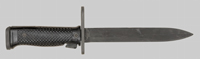         |
Columbus Milpar & Manufacturing Co. | Columbus Milpar and Manufacturing Co. (Milpar) of Columbus, OH, was awarded three contracts for the M6 bayonet, in fiscal years 1961, 1963, and 1966.
Milpar was awarded its very first bayonet contract, DA-11-199-ORD-601, on February 15, 1961. 407,000 M6 bayonets were procured under this contract at a cost of approx. $1.96 each. Initial deliveries were to begin by July 15, 1961, followed by 31,000 bayonets per month until completion. However, by January 2, 1962, only 32,500 bayonets had been delivered. These findings documented by the Government Accounting Office (GAO) show that Milpar's bayonet delivery problems existed from the very beginning. This example was taken from sealed packaging with a December 1961 packing date, so is among the first 32,500 bayonets that Milpar produced. Milpar used a unique cold-stamping process to manufacture blades. While Milpar patented this process in 1962, this example shows that it was used from the outset of Milpar's bayonet production. This process eliminated much of the surface grinding typically required to shape the blade. Only the edge was applied by grinding. Cold-stamped Milpar blades have a distinct “hammered” appearance, where the lines that make up the blade’s profile typically lack the crispness of other contractors' surface-ground blades. The blade spine is chamfered, however, the chamfer's appearance can vary from crisp to almost indistinct. By 1967, Milpar's blade production appears to have changed to a conventional surface-ground blade forming process similar to other contractors; and also began to exhibit a rounded spine. Ca. 1968, Milpar blades began to exhibit what was, in 1968–69, a non-standard curved (or sloped) runout. Some Milpar M6 blades exhibit these characteristics (see Milpar M5A1 bayonet above). These features have been erroneously thought to indicate commercial assembly by surplus dealers. However, the M5A1 example referenced above substantiates that the curved (or sloped) runout was used on U.S. government contract production. Milpar's manufacturing variations were largely a consequence of their incoherent management of the bayonet production process. While some commercial assembly of bayonets using rejected and surplus Milpar parts did occur, manufacturing variations are not necessarily definitive evidence of commercial assembly or fakery. |
Label:
"1005-722-3097-B008 Guard: "U.S. M6" and "MILPAR COL" and Defense Acceptance Stamp (DAS) |
|||||||
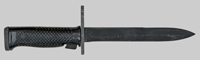        |
This example, also from contract DA-11-199-ORD-601, was taken from sealed packaging with a May 1962 packing date. Contract completion was expected by June 1962, however, this contract may have taken longer to complete.
This example has the Defense Acceptance Stamp (DAS), showing that the DAS was still in use at Milpar in May 1962. |
Label:
"1005-722-3097-B008 Guard: "U.S. M6" and "MILPAR COL" and Defense Acceptance Stamp (DAS) |
||||||||
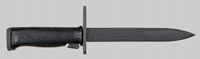 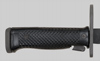 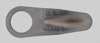      |
Milpar was awarded their second M6 contract, DA-11-199-AMC-270, sometime ca. spring 1963.
According to Cunningham, Milpar delivered 182,804 M6 bayonets during fiscal year 1964 (7/1/63 to 6/30/64) under contract DA-11-199-AMC-270. A calendar year 1963 Small Business Administration (SBA) report indicates that Milpar was awarded a contract for $365,458. The SBA report is not explicit regarding bayonets, however, amount is spot-on for the bayonet quantity that Cunningham reported. This example was taken from sealed packaging with an October 1963 packing date. This example does not have the Defense Acceptance Stamp (DAS), showing that use of the DAS had likely been discontinued at Milpar prior to October 1963. This example was produced after bayonets began to be assembled and packaged at Milpar’s New Lexington, OH, plant from parts manufactured at the Columbus, OH, headquarters plant. |
Label:
"1005-722-3097-B008 Guard: "U.S. M6" and "MILPAR COL" |
||||||||
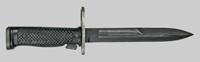 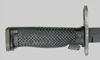 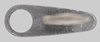 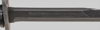   |
This Milpar M6 example is unusual in that the blade clearly exhibits the characteristics of Milpar's cold-stamping process, but is more finely finished than is typically encountered.
It is unclear whether this is one of the earliest examples (e.g., an initial production sample), made when Milpar may have been trying to impress government contract managers; or simply benefitted coincidentally from fresh stamping dies and/or more careful operation of the stamping press. This example has the Defense Acceptance Stamp (DAS), so was likely made early in Milpar's M6 production. The blade is untouched, as evidenced by the presence of the factory edge (white line). Milpar’s cold-stamped blade edge was a two-step, a steep coarsely-ground edge that was finished off with a very fine second edge. Milpar blades had the “white line,” however, it is so thin as to be almost invisible. Milpar’s unique grind produced an edge that was not very sharp to begin with and required significantly more stoning to sharpen than blades from other contractors. These characteristics may give the erroneous impression that Milpar blades left the factory with no white line. However, all of the Milpar M6 examples pictured here exhibit a white line on both the true and false edge. |
Guard: "U.S. M6" and "MILPAR COL" and Defense Acceptance Stamp (DAS) | ||||||||
        |
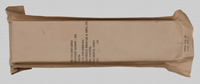
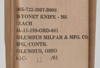
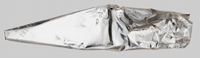
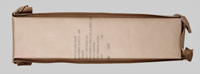
Imperial Knife Co. | This example from the final M6 bayonet contract was taken from sealed packaging.
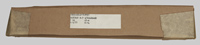
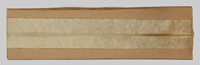
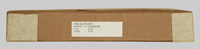
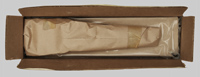
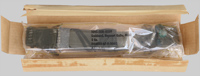
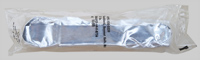
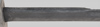
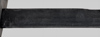
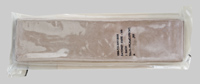
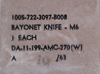
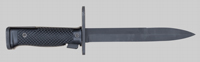
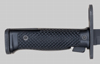
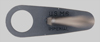
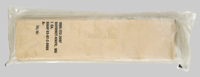
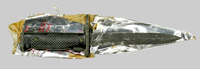
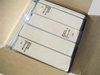
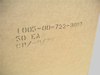
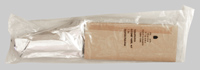
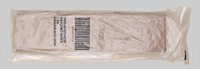
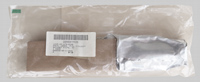
Imperial Knife Co. was awarded contract DAAF-03-67-C-0069 in April 1967. Cunningham indicates that 265,951 bayonets were reportedly delivered under this contract. This quantity is consistent with the amount paid under the contract. This example has an October 1968 packing date. As shown in the images at left, the bayonets were sealed in a foil preservative wrapper inside a cardboard box. The cardboard box is sealed inside a heavy plastic wrapper with a printed label. The wrapped bayonets were packed 50 to a carton. A prolific producer of bayonets and scabbards, Imperial Knife Co. changed its corporate name to Imperial Schrade Corp. in 1984. Imperial’s losing out in the M9 bayonet competition resulted in closure of the Providence, RI, plant in 1987. Imperial Schrade continued operations in Ellenville, NY, until its closure in 2004 after 100 years of operation.
|
Wrapper:
"1005-722-3097" over "Bayonet-Knife, M-6" over "1 Ea." over "DAAF 03-67-C-0069" over "A-" over "10/68" |
|||||||
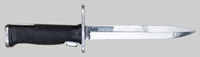 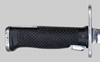 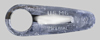 |
Honor Guard Bayonets | This Imperial Knife Co. M6 bayonet was plated for ceremonial use by honor guard personnel.
Older M1, M5A1, and M6 bayonets are still used by the military services for ceremonial purposes. U.S. military honor guards present the colors (U.S. and service branch flags) at special events and perform various roles at military funerals. U.S. military honor guards are typically equipped with either the M1 or M14 rifle. Honor guard bayonets have a hard life. Weapons are dropped in practice resulting in bent and broken blades. I once witnessed an honor guard Marine slam a car’s trunk lid on the muzzle of a M14 rifle held by a fellow Marine. Since these bayonets are no longer available from military stocks, military honor guards have resorted to commercial suppliers. The following provides some examples of how these bayonets have been procured in recent years. General Cutlery, Inc. appears to have been one of the largest suppliers of honor guard bayonets (see below). From at least 2006-present, the U.S. Marine Corps Honor Guard Headquarters at Quantico, VA, has sent bayonets to a Kensington, MD, metals firm for plating. In 2010, the Navy procured “M1 Garand bayonets without scabbard” for the U.S. Naval Academy from Mc Kee, Inc. of Savage MD, (an obvious reference to the late Clint McKee, founder of Fulton Armory). In 2010 and 2011, the Air Force also made procurements of “M-1 Bayonet-Chrome Finish” from Mc Kee, Inc. |
Guard: "U.S. M6 and "Imperial" and Defense Acceptance Stamp (DAS) | |||||||
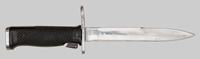 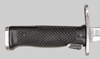 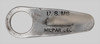   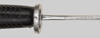 |
This Milpar M6 bayonet was refurbished by welding a new-made facsimile blade on to the original blade stub.
General Cutlery, Inc. is reported to have supplied upwards of 5,000 bayonets used by military honor guards, beginning with the inauguration of President Clinton in 1993 through the inauguration of President Obama in 2009. These procurements were reported to have been facilitated by a “historian.” Historian, Homer Brett, confirmed that he facilitated procurement of honor guard bayonets from General Cutlery for the Army, Navy, Marines, and Coast Guard through 2009. The Air Force Honor Guard Manual also listed General Cutlery as the source from which base honor guards can procure plated bayonets from 2006 (likely even earlier) through at least 2018. General Cutlery obtained surplus or scrap bayonets from importers, including the Civilian Marksmanship Program (CMP). For example, when CMP received bayonets returned by foreign countries, they were randomly dumped into pallet-size wooden shipping crates by the thousands. CMP sorted out the saleable bayonets, then sold bulk crates of the unsalable beaters at scrap prices. General Cutlery obtained beaters from CMP and others; then refurbished and supplied them for honor guard use. Foreign-made equivalents were sometimes mixed in with U.S. bayonets; and, were also refurbished and supplied. To refurbish bayonets with damaged or broken blades, General Cutlery manufactured “facsimile” blades using their old M7 tooling. Reiter Welding, a local, Fremont, OH, welding shop performed the welding and fabrication work. The plated M6 bayonet pictured at left appears to be one of the weld-ups. The bayonet clearly exhibits a crudely-finished facsimile blade welded on to the original blade stub at the ricasso. I want to thank Frank Trzaska and Homer Brett for their assistance in my research on procurement of honor guard bayonets. |
|||||||||
| Haiti | 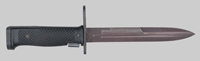 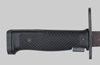 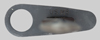 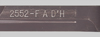 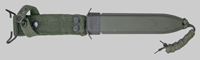  |
M6 | Bayonet-knife for use on the 7.62 mm. NATO caliber U.S. M14 selective-fire rifle.
The history and construction are as described for the M5A1 bayonet above. The blade marking, F A D'H, is an abbreviation for Forces Armées d'Haiti. The scabbard markings are different than on the scabbard, above, and the tie string is present on this example. Haiti reportedly received 1,250 M14 rifles in 1976 via the MAP. However, MAP records do not show any M14s going to Haiti. State Department records document that Haiti requested to purchase M14 rifles in 1974 via Foreign Military Sales (FMS), not MAP, so these were likely delivered via FMS. I haven’t been able to confirm whether any M14 rifles were seized by U.S. Forces during Operation Uphold Democracy in 1994–95. Haitian forces armed with M14 rifles were observed in photographs taken during the 2004 Haitian coup d'état that removed President Jean-Bertrand Aristide from office. |
Blade: "2552 - F A D'H"
Guard: "US M6" Scabbard: "U.S. M8A1" over "Made in W. Germany" |
||||||
| South Korea | 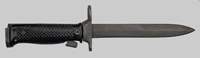 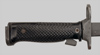  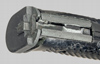  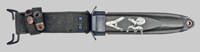  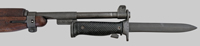 |
M6 Modified for M1 Carbine | U.S. Bayonet-Knife M6 modified to mount to the caliber .30 U.S. Carbine M1.
I had long classified these as unidentified, however, evidence consistently points to their origin as South Korean. As shown in the image at left, the bayonet is a U.S. M6, as identified by the recoil stop in the mortise. The alterations are extensive. The conversion entails what seems to be an impractical amount of work. The original M6 guard was ground down to an oval, then a spacer inserted forward of the original guard, and forward of the spacer, what resembles a M4 guard. The added M4-style guard covers the ricasso up to original blade runout. The spacer and guard were welded to the vestiges of the original guard, then ground narrow to resemble the wartime M4. The guard on this example bears a marking somewhat resembling the 1/8-in. Defense Acceptance Stamp (DAS). The only M4 bayonets to bear this mark were the 1954 Imperial contract (Turner M4s had a 1/4-in. DAS). However, the M4-style guard is quite crude and the mark is indistinct, so may be something altogether different. Internally, the latching lever has been extended (perhaps stretched) at the rear to engage the bayonet lug much closer to the bayonet’s butt plate than on the M6. The upper portion of the butt plate has also been milled away. Cunningham indicates that he spoke with an importer who stated that they had been obtained from South Korea. Bill Porter also indicated that these had appeared along with the South Korean M5 (shortened M1) bayonets. The crudeness of the modifications has cast doubt about these being modified in Korea. However, while not conclusive, documentary evidence appears to support South Korean origin. Only Bolivia, Ethiopia, and South Korea are shown in available Military Assistance Program (MAP) records as receiving M4 bayonets, M6 bayonets, and M1 carbines. Of these three countries, only Ethiopia is reported to have received M14 rifles. MAP records show that Bolivia received only 90 M6 bayonets in 1965, however, South Korea received 10,988 in 1972–73. Perhaps, these conversions were an attempt by the South Koreans to make something useful out of their orphan M6 bayonets, prior to manufacturing K-M4 bayonets.The M8A1 scabbard with this example was assembled at the Pennsylvania Working Home for the Blind 1969–70. |
Guard: Unknown Stamp
Scabbard: "U.S. M8A1" over "TWB" |
||||||
| USA | Pictures (click to enlarge) |
Manufacturer or Type | Description | Blade Length |
Overall Length |
Muzzle |
Markings | |||
| in. | mm. | in. | mm. | in. | mm. | |||||
        |
Colt "New Model" M7 | Bayonet-Knife for use on the Colt-Armalite 5.56 mm. AR–15 assault rifle.
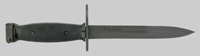
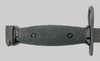
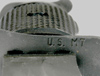
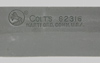
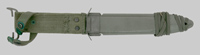
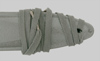
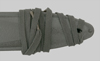
The first of Colt's AR–15 bayonets were made 1961–1962 by Universal Industries of West Haven, CT. They were based on the Second World War M4 bayonet, with a narrow guard and one-piece green or brown plastic grip. Colt assigned them Part No. 62082 in their catalog. While this design was fine for commercial purposes, it had proven unsustainable in U.S. Army service and had been superceded by the M4 Second Production Bayonet in 1954. In 1963, as the U.S. Government became more interested in the AR–15, Colt redesigned their bayonet to better conform to current government specifications. They designated it the "New Model M7" and assigned Part No. 62316 in the Colt catalog. This part number appears on M7 bayonets commercially made for Colt. As shown in this comparison image, Colt's bayonet blade lacked the lightening cuts in the tang area. The hole for the guard securing bar is square (not round) and the blade runout is curved. A few examples with a 90-degree runout have been encountered. As this image reveals, Colt's grips are universal (left same as right) secured with screws and loose hex bolts that fit into hexagons molded into the grips. Colt's scabbard was injection-molded. M.H. Cole indicates “Imperial stated that … the scabbard is made of glass filled nylon [DuPont Nylon 66] with a crinkle type O.D. finish, stamped “U.S. M8A1” and like the bayonet, has no maker mark.” Adding glass to nylon increases its high-temperature strength, wear resistance, and chemical resistance. The roughened finish probably incresed abrasion-resistance. Interestingly, Colt's approach to scabbard manufacture avoided the pitfalls that subsequently plagued the Government's Vietnam-Era M8A1 scabbard production. According to Mr. Robert Roy of Colt Industries, "Part number 62316 is the standard pattern of the M7 bayonet which we have been furnishing since the early 1960's. They have been made by a variety of manufacturers, but in many cases, there are no identifying marks to indicate who the manufacturer is." M.H. Cole indicates that “Imperial [Knife Co.] stated that they made 30,000 of these for Colt.” Mr. Roy also identified Carl Eickhorn Waffenfabrik, in West Germany, as a 1970s producer of Part No. 62316 M7 bayonets for Colt. A quantity of these appeared in 2009, advertised to be new-old-stock 1960s examples. However, it is unclear whether they are 1960s Colt "New Model M7" bayonets or subsequent production by another unidentified manufacturer. |
6.75 | 170 | 11.75 | 295 | .880 | 22.4 | Blade: Colt 'rampant horse' logo, followed by "Colt's 62316," Hartford, Conn USA"
Guard: "U.S. M7" Scabbard: "U.S. M8A1" Glove Fastener: "RAU CO" (partial) |
|
| U.S. M7 Bayonets | The Colt "New Model" bayonet (above) was standardized as the U.S. M7 Bayonet-Knife for use with the 5.56 mm. NATO caliber U.S. M16 assault rifle. The M7 bayonet is not just a M4 Second Production bayonet with a larger muzzle ring. The M7 hilt (and grips) are longer than the M4. The M16 rifle's bayonet lug is also wider than that of the M1 Carbine, so the bayonet latch plate dimensions differ accordingly. Procurements began in 1964 and have continued through 2023 (so far). Since 2005, Ontario Knife Co. has been the sole producer.
A total of 30 M7 bayonet contracts appear to have been let. U.S. government prime contractors and approximate years of production include: An estimated quantity of approximately 4.2 million M7 bayonets have been produced to date. Additional information is also found in the M7 Bayonet Contracts Summary. |
|||||||||
| Manufacturer | Description | Markings | ||||||||
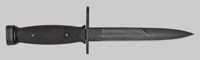 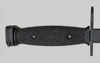 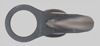   |
Columbus Milpar & Manufacturing Co. | Milpar was awarded contract DA-11-199-AMC-625 in May 1964, the first U.S. government M7 bayonet contract. Cunningham reported that 93,498 bayonets were delivered under this contract.
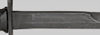
Milpar's Fiscal Year (FY) 1966 and 1967 M7 contracts are not well-documented. Four additional contracts awarded to Milpar are believed to be for M7 bayonets. The M7 Bayonet Contracts Summary includes information regarding Fiscal Year 1966–67 Milpar Contracts That Analysis Suggests Were for M7 Bayonets. Cunningham reported 563,530 M7 bayonets produced under Milpar's FY 1966 and 1967 M7 contracts. This quantity is consistent with the amount paid under what are believed to be Milpar's FY 1966 and 1967 M7 bayonet contracts. Characteristic of Milpar's chronic bayonet delivery problems, initial production samples from the May 1964 contract were apparently not delivered until February 1965. Milpar produced M7 bayonets until their government contract bayonet production ended in March 1969. Typical of most Milpar M7 bayonets, the example pictured at left exhibits characteristics of Milpar's unique cold-stamping process. The latch plate has a chevron mark unique to Milpar M7 bayonets. The significance of this mark is undocumented, however, it is most likely related to hardness testing. According to Cunningham, the chevron-marked bayonets were “early production.” This has sometimes been misinterpreted by collectors to indicate “first contract.” However, examples observed with the chevron are far too numerous to have been limited to just Milpar’s first M7 contract. |
Guard: "US M7" and "Milpar"
Latch Plate: chevron |
|||||||
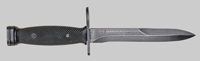 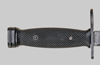 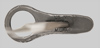    |
This Milpar M7 has been personalized as a presentation piece.
The blade inscription reads: SGT. JOHN R. ALLGOOD By 1967, Milpar's blade production appears to have changed to a conventional surface-ground blade forming process similar to other contractors; and also began to exhibit a rounded spine. Ca. 1968, Milpar blades began to exhibit what was, in 1968–69, a non-standard curved (or sloped) runout. Some Milpar M7 blades exhibit these characteristics (see Milpar M5A1 bayonet above). These features have been erroneously thought to indicate commercial assembly by surplus dealers. However, the M5A1 example referenced above substantiates that the curved (or sloped) runout was used on U.S. government contract production. This example's blade exhibits the characteristic of late Milpar production (ca. 1968-69). The latch plate also lacks the chevron mark, instead having a more typical hardness-testing dimple. Milpar had production output and quality issues from mid-1966 onwards that culminated in a government-ordered shutdown of bayonet production in January or February 1968. Whittaker Corporation's acquisition of Milpar was finalized almost concurrent to the government shutdown. Significant reworking of the production line appears to have occurred under Whittaker Corp. oversight, followed by Whittaker's replacement of Milpar's bayonet plant supervisors. It is likely that the curved runout was introduced at this point, although the specific production line changes have not been documented. Milpar's manufacturing variations were largely a consequence of their incoherent management of the bayonet production process. While some commercial assembly of bayonets using rejected and surplus Milpar parts did occur, manufacturing variations are not necessarily definitive evidence of commercial assembly or fakery. The bayonet came in an issued M8A1 scabbard that still has the restraining lace. This makes sense given the bayonet’s attribution, as airborne use was the requirement for including a restraining lace on the M8A1 scabbard. |
Guard: "US M7" and "Milpar"
Latch Plate: dimple Blade: (see description) |
||||||||
|
|
Bauer Ordnance Corp. | Bauer Ordnance Corp. of Warren, Michigan, was awarded contract DAAF-01-69-C-0224 in October 1968. Milpar was the low bidder, however, federal contracting officials had finally lost patience with Milpar's late deliveries and quality control problems.
Cunningham indicates that 1,835,392 bayonets were reportedly delivered by Bauer during FY 1969. This quantity is consistent with the amount paid under this contract. Aetna Tool & Die Co. of Centerline, MI, appears to have produced the blade blanks for Bauer's M7 bayonets. Also at left is an example still sealed in its factory wrapping, with a 12/69 packing date. Note how the cardboard box is ink-stamped with the Defense Acceptance Stamp (DAS). Bauer Ordnance Co. was formed in 1966 by Russell E. Bauer, after leaving his position as president of Cadillac-Gage Co. As president of Cadillac-Gage, it was Bauer who hired Eugene Stoner to develop the Stoner 63 Weapons System. A prolific inventor with nearly 30 patents to his name, he patented a wire-cutter version of the M7 bayonet in 1973. Bauer’s post-Cadillac-Gage business interests were extensive and varied. Bauer Ordnance Co. was acquired by Canoga Electronics Corp. of Chatsworth, CA, in 1969. |
Guard: "US M7" and "BOC"
Wrapper: "1005-073-9238" over "Bayonet, M7" over "1 Each" over "DAAF-01-69-C-0224" over "A" Box: Defense Acceptance Stamp and "12/69" |
|||||||
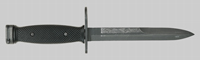 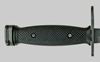 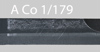 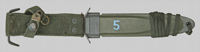 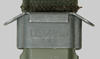 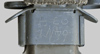 |
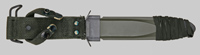
This example is unit-marked, something not officially done in the U.S. The marking is crudely scratched into the blade and on the reverse of the scabbard throatpiece, probably by a unit armorer.
The marking reads “A Co 1/179”. This identifies A Company, First Battalion, 179th Infantry Regiment. The 179th Infantry Regiment has a long history in the Oklahoma National Guard as part of the 45th Division (today, 45th Infantry Brigade Combat Team). The 179th served in both World Wars and the Korean War. During the Second World War, Gen. George S. Patton considered the 45th Division the best Division in the 7th Army, which he commanded during the North African and Sicilian invasions. When the 45th Infantry Division moved to Korea in December, 1951, it was the first National Guard division to go into combat in Korea. It first served in the Yonchon-Chorwon area, and in sectors fronting Old Baldy, Pork Chop Hill, Heartbreak Ridge and Luke's Castle. The 179th also served in Bosnia in 2000 as part of the UN Peacekeeping mission, the Iraqi Surge of 2008; and, subsequently in Afghanistan. The M8A1 scabbard with this example was assembled at the Pennsylvania Working Home for the Blind 1969–70. |
Blade: "A Co 1/179" scratched into blade.
Guard: "US M7" and "BOC" Scabbard: "M8A1" over "TWB" also "A Co" over "1/179" scratched into reverse side of throatpiece. |
||||||||
    |
Conetta Manufacturing Co. | Conetta Manufacturing Co. of Stamford, Connecticut, was awarded two M7 bayonet contracts: DA-11-199-AMC-723 in June 1966 and DAAF-01-68-C-0431 in December 1967. Two orders were placed under contract 723 and three orders were placed under contract 0431, totalling $1.3 million.
Cunningham indicates a total quantity of 310,000 from Conetta's two 1966–69 M7 contracts. However, this quantity is unreasonably low for the total amount reported paid. Conetta’s company history was somewhat messy; and here it further clouds the picture. When Conetta’s successor, Dynetics Corp., filed to become a publicly-traded corporation in 1970, it listed an outstanding debt of $323,358 to “repay progress payments from the U. S. Government on government contracts.” There is no record of any government prime contract with Dynetics, so the debt appears to have been inherited from Conetta. During 1965–69, Conetta had contracts for: bayonets, Mark 2 knives, bayonet parts, and other weapons components. We don’t know which contract(s) Conetta may have shorted. Even if the entire outstanding debt inured to M7 deliveries, the quantity delivered would have exceeded 310,000 by a wide margin. |
Guard: "U.S. M7" and "Conetta"
Latch Plate: single punch mark |
|||||||
    |
Fraser Manufacturing Corp. | Fraser Manufacturing Corp. of Lexington, Michigan, was awarded contract DAAF-01-72-C-0188 in October 1971. A second order under this contract was placed in September 1972.
Fraser had hundreds of government contracts and was most well-known for its design and production of vehicle mounts for machine guns. Only one Fraser contract appears to be associated with the M16 rifle, resulting in two orders, both of which I believe are for M7 bayonets. No production quantity has surfaced. However, based on the dollar amount of the orders ($99,000) and the value attributed to M7 bayonets provided to foreign governments in 1971–72 (averaged $2.44 each), the number of bayonets produced appears to be in the neighborhood of 40,000, which explains their scarcity. Manufacturer symbols are assigned by DOD. FSR had already been assigned to another firm, Fort Smith Rim & Bow Co. of Ft. Smith, AR, so Fraser was assigned FZR instead. A family business founded in 1947 as Fraser Reel and Specialty Co., they primarily manufactured fishing reels in Fraser, Michigan. The mid-1950s were hard times for American fishing tackle makers after tariffs on imported fishing tackle were reduced beginning in 1951. Fraser adapted by relocating to Lexington in 1952 (some sources say 1950, however, their legal filing with the State says 1952). The company broadened its scope to manufacturing of machine shop and metal products, including automobile and boat parts; and sporting goods. The company name was changed to Fraser Manufacturing Corp. in 1963. By the 1970s, 75 percent of Fraser’s production were government contracts. At its peak, Fraser employed approximately 100 workers. Fraser operated until 2013, when the family closed the factory and retired; auctioning off the machinery and donating the building and property to their local school district. |
Guard: "U.S. M7" and "FZR"
Latch Plate: single punch mark |
|||||||
    |
Imperial Knife Co. | Imperial Knife Co. of Providence, Rhode Island was awarded a total of six M7 bayonet contracts 1973–84.
Imperial Knife Co. of Providence, Rhode Island, was founded in 1914 by brothers Felix and Michael Mirando; and Domenic Fazzano. After Albert Baer purchased Ulster Knife Co. of Ellenville, New York, in 1941, Imperial and Ulster merged in 1942. During the Second World War, Imperial produced M3 knives, M4 bayonets, and many other edged weapons and tools. In 1946, Albert Baer purchased Schrade Cutlery Corp., which also became a division of Imperial. Imperial’s influence on Post-War bayonet development and production is unmatched by any other government contractor. Imperial was active in Post-War bayonet and scabbard design and production for 34 years, from 1952–1986. Michael Mirando helped design the M5 bayonet in 1952 and bring it to production. Imperial was also the first producer of the M4 Second Production bayonet. Imperial produced the M6 bayonet during the 1960s; the M5A1 bayonet during the 1960s and 1970s; and, the M7 bayonet during the 1970s and 1980s. Imperial was the first producer of the M10 scabbard in 1985. Imperial Knife Co. changed its corporate name to Imperial Schrade Corp. in 1984. Imperial Schrade’s M10 scabbard contract appears to be their last U.S. government prime contract. Imperial’s losing out in the M9 bayonet competition resulted in closure of the Providence, RI, plant in 1987. Imperial Schrade continued operations in Ellenville, NY, until its closure in 2004 after 100 years of operation. The company trademarks were purchased by investors, who still use the Imperial and Schrade branding on knives made in China. |
Guard: "U.S. M7" and "Imperial"
Latch Plate: single punch mark |
|||||||
    |
Imperial Knife Co. was awarded its first two M7 contracts in 1973. Production under both contracts appears to have occurred contemporaneously. A total of 361,800 bayonets were reportedly delivered under these contracts. This quantity is consistent with the amount paid under these contracts.
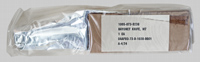
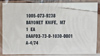
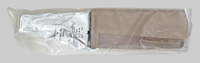
This example is from the first 1973 contract, DAAF-03-73-D-1030, with an April 1974 packing date.
|
Inside Label: 1005-073-9238 Plastic Wrapper: 1005-073-9238 |
||||||||
    |
This example is from the second 1973 contract DAAF-03-73-D-1046, with a December 1973 packing date. | Inside Label: 1005-073-9238 Plastic Wrapper: 1005-07-9238 |
||||||||
   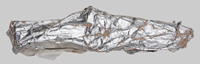 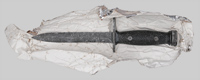 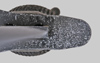 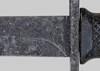 |
This example is from the last M7 bayonet contract awarded to Imperial Knife Co.
Contract DAAA-09-85-C-0504 was awarded in April 1984. This contract was not identified in Cunningham. This example was packaged in December 1984. The quantity produced has not been found. Based on the $240,000 paid under this contract, the quantity was likely in the 35,000–40,000 range. The white substance seen in images of the bayonet is a preservative applied when the bayonet was packaged. The curved edge runout seen in images at left is typical of later Imperial M7 bayonets from the 1980, 1893, and 1984 contracts. |
Label (wrapper):
"1005-00-073-9238 Carton: A 12/84 Guard: "US M7" and "Imperial" |
||||||||
     |
General Cutlery Inc. | General Cutlery, Inc. of Fremont, Ohio, was awarded three M7 bayonet contracts. General Cutlery was also a M7 bayonet subcontractor for Lan‑Cay Inc. (see below).
A feature of General Cutlery M7 bayonets is that the factory edge is often more heavily ground than on bayonets from other contractors. The edge is visible on this example that was removed from sealed packaging to be photographed. General Cutlery was founded ca. 1945. In 1950, the company was purchased by Carleton Reitz and two partners, becoming the firm as we know it. His son, David, worked at the company, and served as owner/president following the passing of Carleton Reitz in 1999. The company was small, typically 10–20 employees. The plant where M7 bayonets were manufactured was a former rural elementary school campus west of Fremont, Ohio, that General Cutlery purchased in 1982 and converted into a factory. Primarily a producer of kitchen knives, the plant, equipment, and workforce were geared toward manufacturing at a level of commensurate with the M7 bayonet. When Lan Cay subcontracted its M9 blade production to General Cutlery in 1992, the M9 blade and its more exacting manufacturing standards proved beyond the plant’s capability. Following their production of government-contract M7 bayonets, General Cutlery sold bayonets and knives commercially. They also are reported to have supplied upwards of 5,000 refurbished bayonets used by military honor guards. General Cutlery still appears to own the Fremont factory. A photographic survey of the plant in 2019 showed evidence of activity, while a more recent 2022 survey did not. In 2023 the company’s status changed to permanently closed. |
Guard: "U.S. M7" and "Gen Cut" | |||||||
  |
This example is from the first M7 bayonet contract awarded to General Cutlery. Contract DAAA09-85-C-0540 was awarded in March 1985.
Cunningham reported quantity of 45,800. However, the quantity is too low for the $502,000 paid under the contract, so this must have been a partial report. The true quantity produced under this contract is likely more in the neighborhood of 75,000. |
Label:
"1005-00-073-9238 |
||||||||
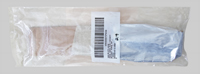  |
This example is from the second M7 bayonet contract awarded to General Cutlery, contract DAAA09-87-C-0931.
This contract was not known until 2022, when the example pictured at left turned up in sealed packaging. No record of this contract exists in federal government contracting databases. I made an inspection slit in package to verify the manufacturer. The quantity produced under this contract is unclear. |
Label:
"1005-00-073-9238 |
||||||||
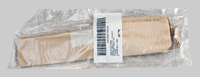 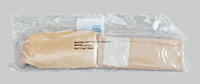 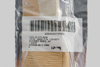 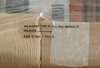 |
This example is from the third M7 bayonet contract awarded to General Cutlery. Contract DAAA09-88-C-0366 was awarded in January 1988.
Cunningham reports various figures for the delivery quantity: 24,400; 56,801; and 81,201 (sum of the first two). 56,801 is consistent with amount paid, so is likely correct.
|
Label:
"1005-00-073-9238
|
||||||||
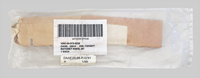  |
Lan Cay Inc. | Lan‑Cay Inc. of Carrolton, KY, is well known for its production of the M9 Bayonet. However, Lan‑Cay was also awarded two contracts for the M7 bayonet. Lan‑Cay had no cost-effective way to produce M7 bayonets, so subcontracted production to General Cutlery Co. The resulting bayonets are marked "Gen Cut" just like those produced by General Cutlery during the 1980s.
Frank Trzaska and William Humes first reported, ca. 2000, that Lan‑Cay, was awarded small contracts for the M7 Bayonet and M10 Scabbard in 1998. Lan‑Cay was awarded contract DAAE20-98-P-0241 in May 1998. At only 1,287 bayonets, it is the smallest known U.S. Government M7 bayonet prime contract. Lan‑Cay accepted this contract (and another for M10 scabbards), four weeks after the government exercised a pending $246,000 contract option enabling Lan-Cay to continue producing M9 bayonets. Note how the label printed on the plastic wrapper has General Cutlery's CAGE Code, 20014; and the adhesive label below has the Lan‑Cay’s contract number. |
Label:
"1005-00-073-9238 |
|||||||
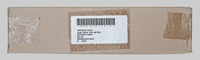 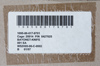 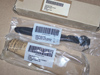 |
Lan‑Cay was awarded contract W52H09-06-C-0002 in November 2005. The existence of this contract was not recognized until examples in original packaging surfaced in 2023. Up to now, the only recognized producer of the M7 Bayonet/M10 Scabbard Combo (National Stock Number 1095-00-017-9701) has been Ontario Knife Co. These findings change that.
The contract amount was $257,987, which suggests that the quantity produced was in the neighborhood of 12,000. At $257,987, the contract required competitive bidding but the government justified awarding it to Lan‑Cay on a sole-source basis due to “urgency.” This urgent contract was supposed to be completed in six months (by May 2006). General Cutlery required two delivery extensions until November 2008, taking three years to complete the order. This may help explain why, since 2005, Ontario has been the government’s sole supplier of M7 bayonets and M10 scabbards. Note how the package label has Lan‑Cay’s contract number along with General Cutlery's CAGE Code, 20014. |
Carton Label:
"1095-00-017-9701 Bayonet Package: "1005-00-073-9238 |
||||||||
      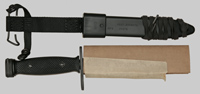  |
Ontario Knife Co. | Ontario Knife Co. of Franklinville, New York, has been awarded six prime contracts involving the M7 bayonet. In addition, Ontario has been subcontracor on three more M7 bayonet procurements. Ontario's contracts sometimes include M10 scabbards, either packaged together with the M7 bayonet or packaged separately. Ontario has been the Government's sole source of M7 bayonets since 2005, with its most recent production run occurring in 2023.
This example is from the first bayonet contract awarded to Ontario Knife Co. in October 1987. Contract DAAA-09-88-C-0129 was also the first contract providing for a new-made M7 bayonet and M10 scabbard packaged together. 58,100 bayonets were reportedly delivered under this contract 1987–88. This quantity is consistent with the amount paid under this contract. These were catalogued under NSN 1005-00-017-9701: Bayonet-Knife M7 with Scabbard. This NSN applies regardless of the scabbard type packaged with a M7 bayonet. It has been used since the 1970s on repacks of existing M7 bayonets that combined the bayonet and a M8A1 scabbard into a single carton. Ontario Knife Co. was founded in Naples, NY, in 1889, taking its name from the county where it was founded. The firm moved to Franklinville, NY in 1902. The company was purchased in 1967 by Servotronics, who has since served as Ontario’s parent company. In addition to developing a huge catalog of commercial knives, Ontario became the primary producer of edged weapons for the U.S. Government during the post-9/11 period. Ontario amassed over 600 prime contracts since 2008, including the: M7 bayonet; M10 scabbard, M9 bayonet; OKC3S bayonet; and, a variety of combat knives, survival knives, and other edged tools. Servotronics is primarily a manufacturer of servo controls and other high technology products used in aircraft, jet engines, missiles, manufacturing equipment. In a strategic move, Servotronics determined to divest its consumer products group of which Ontario Knife Co. was a part. By 2023, there were 56 employees remaining at the Franklinville plant. Blue Ridge Knives, one of Ontario’s existing wholesale distributors, purchased the company for $2.1 billion at the end of July 2023 and immediately closed the Franklinville plant, ending its 121 years of operation. As Ontario has been the government’s sole source of bayonets and scabbards since 2005, their closure leaves a significant void to be filled going forward. |
Label:
1005-00-017-9701 |
|||||||
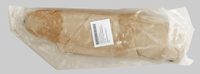 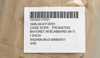 |
This example is from the second run that Ontario Knife Co. produced of the M7 Bayonet/M10 Scabbard combo.
Sealed in its factory wrapping are both the M7 bayonet and a black M10 scabbard. Contract W52H09-06-D-0068 was awarded in 2006. It was a massive indefinite-delivery contract that included M7 bayonets, M10 scabbards, the M7/M10 combo, M9 bayonets, and various spare parts for the M9 system. The M7/M10 combo was made 2006–10 under this contract, with a total of 90,000 delivered. This example was made in 2009. |
Label:
"1095-00-017-9701 |
||||||||
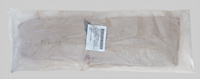  |
This example is from the last M7 bayonet prime contract awarded to Ontario Knife Co. More recent contracts were fulfilled by Ontario via a middleman who served as prime contractor.
Contract SPM7L1-11-M-D867 was awarded in August 2011. This contract was for the M7 bayonet without scabbard. 3,746 bayonets were delivered under this contract. This example was packaged in October 2011. |
Label:
"1095-00-017-9701 |
||||||||
|
|
M7 Bayonet w/Scabbard Repacks | During the 1970s and 1980s, the U.S. Government repackaged existing stocks of unissued M7 bayonets with an unissued M8A1 scabbard. National Stock Number (NSN) 1005-00-017-9701 was assigned to catalog these as: Bayonet M-7 w/Scabbard.
The bayonets are typically found sealed in their original packaging. M8A1 scabbards were packaged in pairs, so these were removed from their original packaging, wrapped individually in a piece of brown Kraft paper, and inserted into a cardboard carton with the bayonet. Bayonets observed from these packages have been mostly from Bauer Ordnance Corp. and Imperial Knife Co. Scabbards are mostly PWH and TWB, with a few of the earlier makers encountered. Some of the labels feature the European spelling "Bajonet," suggesting that some of the repackaging work may have been contracted out to firms there. |
Label: 1005-00-017-9701 |
|||||||
| Pictures (click to enlarge) |
Type | Description | Blade Length |
Overall Length |
Muzzle |
Markings | ||||
| in. | mm. | in. | mm. | in. | mm. | |||||
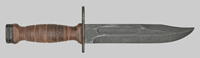 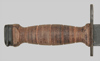  |
Commercial M7 Bowie | This commercial bayonet was inspired by an experimental bayonet considered during the Vietnam War which was not adopted.
It marries a U.S. Navy Mk. 2-style clip-point blade with a M7 bayonet crosspiece and latch plate assembly. Examples are found with both stacked leather and plastic grips. According to Frank Trzaska, they were assembled by New Jersey (today, Pennsylvania) surplus dealer SARCO, Inc., using parts they purchased from Conetta's liquidation sale. Although a very cool-looking bayonet, these are neither rare, experimental, military, nor worth big bucks. |
6.875 | 175 | 11.75 | 300 | .880 | 22.4 | Ricasso: "U.S." over "Conetta" | |
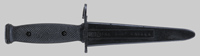    |
U.S. Army M7 Training Aid | Plastic training aid bayonet used by the U.S. Army at Ft. Benning, GA.
Comprised of a crude casting of a M7 Bayonet-Knife hilt and crosspiece with a thick, rounded plastic blade. There is no mortise cast into the pommel, so it cannot be fixed to a rifle. Consequently, it was most likely used for training soldiers how to disarm a knife-wielding assailant. The muzzle ring is broken, which suggests that this example has seen some rough use. Devices Fabrication is the U.S. Army entity responsible for the design and fabrication of training devices such as pugil equipment, targets, rubber ducks (e.g., M4, M16A2, M240B, M60, M249), Improvised Explosive Device (IED) training aids, fox hole stands, weapon mock-ups, and many other devices. There were four Army-wide fabrication sites: Fort Benning, GA; Fort Gordon, GA; Fort Jackson, SC; and Fort Knox, KY. TAD-066 was the official U.S. Army training aid designation for "Bayonet, Plastic." This example was made at the U.S. Army Training Support Center (TSC), Sand Hill, Fort Benning, GA, according to the provenance that accompanied it. |
6.50 | 165 | 11.25 | 286 | .870 | 22.1 | Blade: "Device Shop TAD-066A" | |
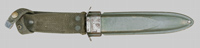
| M8 and M8A1 Scabbards | The Second World War U.S. plastic scabbard design and initial test samples were developed by Edwin L. Beckwith (son of Beckwith Manufacturing Co. founder Harry H. Beckwith) and chemist, Charles P. MacIver, both of whom were employed at the Beckwith Manufacturing Co. shoe component subsidiary, Felt Process Co. After the government contracted with Beckwith Manufacturing Co. to produce scabbards, Harry Beckwith created a new subsidiary, Victory Plastics Co., to manufacture them. The scabbard contracts originating with the Beckwith parent company is why the steel throatpieces are marked "B. M. Co.”, while scabbard bodies bear the Victory Plastics Co. "Vp" mark. Edwin Beckwith served as president of Victory Plastics Co. for its entire 23-year existence.
Beckwith Manufacturing Co. was headquartered in Dover, NH. Victory Plastics Co. was located in Hudson, MA. The Dover, NH, Beckwith plant manufactured shoe components and never had involvement with scabbards. All M8A1 scabbards produced under Beckwith's government contracts were manufactured by Victory Plastics Co. in Hudson, MA. Many M8 scabbards were modified with the M8A1 strap assembly during the mid-1950s. The Korean War and foreign distributions under the Military Assistance Program depleted existing stocks of M8A1 scabbards. Distribution of the M5 bayonet in early 1954 created a necessity for some units receiving M5 bayonets to modify M8 scabbards as a stopgap measure. Local approaches to modification resulted in the variations encountered today. The original markings were left alone, because surface grinding would excessively weaken the sheet steel fitting. Once modified, scabbards were designated M8A1 regardless of the marking. Victory Plastics Co. was the sole producer of M8 and M8A1 scabbards from 1943–1961. The history of Beckwith Manufacturing Co., Victory Plastics Co., and their scabbard production has been well-documented by authors/researchers, Gary Cunningham and Frank Trzaska. Gary’s research can be found in his books and findings of both on Frank Trzaska’s great site, http://usmilitaryknives.com. My research (below) adds a few more details regarding their post-War production. Vietnam War Era M8A1 scabbard producers and their production has been a less well understood area that has posed significant challenges to researchers due to lack of available federal contract data covering the first half of the 1960s. It has been a long struggle to document who the producers were, in what time frames they made their scabbards, and what their respective manufacturing processes entailed. As with any story that is pieced together over time, there have been advances, as well as errors, made along the way. Some unanswered questions still remain. However, as of 2021, a relatively clear and coherent chronology has finally emerged. The two- or three-letter codes found on Vietnam-Era M8A1 scabbards are known in the Department of Defense (DOD) as “Manufacturer Symbols.” These are unique identifiers officially assigned by DOD to certain types of contractors. M8A1 Scabbards produced during the Vietnam War Era are found with the following manufacturer symbols: PWH, TWB, VIZ, VIZ/WD, and WD. U.S. government prime contractors, their manufacturer symbols, and approximate years of production include: —Viz Manufacturing Co.: VIZ 1962–63 Details and supporting evidence regarding production at the Pennsylvania Working Home for the Blind can be found in my article: M8A1 Scabbards Produced at the Pennsylvania Working Home for the Blind (ref. SABC Journal Volume 91, Spring 2015). Details and supporting evidence regarding production at Wilson-Duggar Co. and Viz Manufacturing Co. can be found in my article: 1960s U.S. Scabbards Produced by Viz Manufacturing Co. and Wilson-Duggar Co. (ref. SABC Journal Volume 121, Fall 2022). The following high-level synopsis reflects these findings and summarizes what has been documented regarding production of Post-War M8A1 scabbards. Additional information is available in the Post-War M8A1 Scabbard Contracts Summary. |
|||||||||
| Manufacturer | Description | Markings | ||||||||
     |
Victory Plastics Co. | The Second World War M8 Scabbard was produced beginning in 1943 to replace the leather M6 scabbard originally fielded with the M3 Combat Knife.
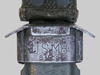
The M3 Combat Knife was intended for issue to troops not armed with rifles and bayonets, so the strap assembly (belt hanger) did not incorporate the wire hanger used with the cartridge belt. The scabbard incorporated a leather "restraining lace," proper term for what collectors often refer to as the “leg tie” or “boot lace.” This was deemed necessary for use by airborne troops who needed to securely fasten the scabbard point during parachute operations. According to Cunningham, approximately 1.7 million M8 scabbards were produced from July 1943 to April 1944. Cunningham indicates that the B in the top plate mark represented Beckwith and the N New England Pressed Steel Co. of Natick, MA, who fabricated the steel fitting. This example's low-numbered top plate and Victory Plastics mold marks show that this is an early M8 scabbard. |
Throatpiece: "U.S. M8" over "B.M Co."
Top Plate: "B 1/3 N" Body: "Vp 2" |
|||||||
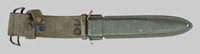     |
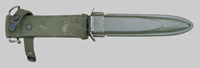
The M3 knife's introduction for infantry use revealed limitations in the M8 scabbard. In addition to lacking the wire hanger needed for attachment to the cartridge belt, the strap assembly was also too short to slide over the cartridge belt, itself.
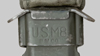
In early 1944, the design was amended to both lengthen the strap assembly and incorporate a wire belt hanger. As amended, the scabbard was designated M8A1. According to Cunningham, approximately 3.1 million M8A1 scabbards were produced from April 1944 to August 1945. The first new-made M8A1 scabbards used steel fittings marked "M8" until these were used up. Cunningham's research found that top plate marks 2/2 running up to about 3/3 were made as M8A1 but are still marked M8 on the throat. This example's top plate mark is 2/9, which is clearly in that range. |
Throatpiece: "U.S. M8" over "B.M Co."
Top Plate: "B 2/9 N" Body: "Vp 45"
|
||||||||
 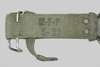    |
This example is a Second World War M8A1-marked scabbard.
The belt strap assembly marking shows that it was treated with a Moisture Fungus Proofing chemical in March 1953. The throatpiece and scabbard body have also been painted. |
Throatpiece: "U.S. M8A1" over "B.M Co."
Top Plate: "B 4/1 N" Body: "Vp 47" Strap Assembly: "M-F-P" over "3-53" |
||||||||
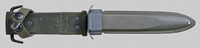 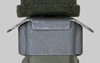    |
During the 1950s, Victory Plastics manufactured M3, M7, and M8A1 scabbards. Victory Plastics' first Post-War M8A1 scabbard production contract has long been attributed to 1953. Recent discoveries found documentation of two scabbard contracts awarded to Victory Plastics during this period:
Fiscal Year 1953: A $220,000 contract for “scabbards” awarded in September 1952 with an initial delivery date of March 1953. It is not documented whether this contract included M8A1 Scabbards. Packaging has been observed of M7 scabbards with July and August 1953 packing dates under contract DA-19-020-ORD-2905. Fiscal Year 1954: A $155,560 contract for "M8A1, scabbard, bayonet, knife" awarded sometime during January-June 1954. Victory Plastics Co. was awarded a research & development contract, DA-19-020-ORD-2399, which led to a September 1954 final report titled “M-8 Fiberglass Scabbard for M-4 Bayonet Knife, Project TS2-2028.” TS2-2028 was a Springfield Armory project related to coontinued development of the lightweight .30 cal rifle (i.e. the M14). This contract was likely the research & development that led to the M8A1 scabbard design changes observed on Post-War M8A1 scabbards. The manufacturer’s mark used on Victory Plastics' Post-War scabbards was “V.P. Co.”, instead of “B.M. Co.” The 1955 merger creating Beckwith-Arden Inc. legally terminated the existence of Beckwith Manufacturing Co. This required discontinuance of the "B.M. Co." marking, , a fact which would have been known internally by 1954 when the documented M8A1 scabbard contract was signed, even if it were not yet public knowledge. Whether this would have been so in September 1952 is less certain, casting some doubt as to whether the first contract included M8A1 scabbards (or if it did, how they were marked). The 1950s scabbards differed from wartime M8A1 scabbards in only small details. However, Cunningham indicates that a design change was implemented during 1950s M8A1 production to increase the amount of offset between the belt strap assembly (belt hanger) and scabbard body, by lengthening the steel top plate flange. This was done to better accommodate the M5 bayonet’s wider crosspiece. Following completion of their 1950s scabbard production, the machinery and tooling was stored on-site at the Victory Plastics plant and kept in working order at government expense. This was part of a post-Korean War government program to ensure that ordnance items could be more rapidly brought to production should the need for rapid mobilization of troops occur again. |
Throatpiece: "U.S. M8A1" over "V.P. Co."
Top Plate (underside): Vp 4" Body (reverse): "Vp 31" |
||||||||
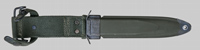 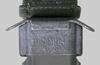    |
Victory Plastics was again awarded a M8A1 Scabbard production contract in January 1961. The 1961 scabbards incorporated the metal tip protector and reversal of the hilt strap arrangement. Scabbard bodies from this contract were also marked on the reverse with the Defense Acceptance Stamp (DAS) in black ink using a ½-inch rubber stamp.
Victory Plastics also manufactured M1917 scabbards 1962–63, however, lost out in two successive M8A1 scabbard procurements: to Viz Manufacturing Co. in August 1962 and Wilson-Duggar Co. in July 1963. The October 1964 death of Harry H. Beckwith thrust Victory Plastics President, Edwin L. Beckwith, into overall responsibility for Beckwith-Arden Inc. and all of Beckwith’s subsidiaries. Victory Plastics closed, followed by the 1965 sale of its plastic molding machinery and building. |
Throatpiece: "U.S. M8A1" over "V.P. Co."
Top Plate (underside): Vp 8" Body (reverse): "Vp F" and DAS stamp |
||||||||
|
|
Viz Manufacturing Co., Inc. | The firm we know as Viz Manufacturing Co. was a highly sought-after Philadelphia, PA, government contractor who also manufactured electronic weather instruments and sensitive electronics used in munitions. The company's name was actually Molded Insulation Co., Inc. from 1932, when Victor I. Zelov acquired it from the Bendix Corp., until 1965, when he formally changed the corporate name to Viz Manufacturing Co., Inc.
Viz Manufacturing Co. of was the immediate successor to Victory Plastics Co., producing M8A1 scabbards during 1962–63 (contract DA-11-199-ORD-728). In 2020, original manufacture heat-sealed cellophane packages containing VIZ M8A1 scabbards labeled with an August 1962 contract date and March 1963 packing date were discovered by collector/researcher Boyd M. Jenkinson, Jr., conclusively proving that Viz Manufacturing Co. produced M8A1 scabbards much earlier than was previously understood. Insufficient data exists to estimate how many M8A1 scabbards that Viz Manufacturing Co. produced. The estimate published in my 2015 article of 50,000 is likely too low (and should now be considered erroneous). This figure was based on Viz Manufacturing Co’s 1969 scabbard contract, which has since been proven to have been for plastic M1917 bayonet scabbards. Although Viz only produced M8A1 scabbards 1962–63, it appears that Viz and its owner, Victor I. Zelov, continued to influence M8A1 scabbard production until the last government-contract M8A1 scabbard was produced in 1970. Zelov maintained a self-imposed ceiling of 498 employees to ensure Viz Manufacturing’s eligibility for small-employer federal contracting preferences. This self-imposed workforce ceiling would later constrain M8A1 scabbard production, likely contributing to adoption of the M10 scabbard. Completed M8A1 scabbards were packaged in pairs, encased in a heat-sealed cellophane wrapper, which was placed inside a cardboard carton. The sealed package pictured at left is badly yellowed, suggesting that the cardboard carton has been absent for a long time. Viz also produced two types of plastic machete sheaths 1966–67 and plastic M1917 bayonet scabbards 1969–70. Bureaucratic inconsistencies resulted in creation of a new federal contractor identity for “Viz Mfg. Co.” well before the 1965 corporate name change; and the continued letting of new federal contracts under the company’s “Molded Insulation Co. Inc.” identity as late as June 1967. The concurrent use of two contractor identities likely enabled the symbol VIZ to be used on M8A1 scabbards in 1962–63, instead of the (Molded Insulation) company’s officially-assigned manufacturer symbol ML. When the company formally changed its name to Viz Manufacturing Co., in 1965, DOD found that another firm, Curtis Mfg. Co. - Visioneering-Bunnel Division, of Cleveland, OH, was already assigned the symbol VIZ. Eventually, VZM was assigned as Viz Manufacturing Co’s. manufacturer symbol. This is how VZM came to be used on M1917 scabbards and machete sheaths. |
Label:
1095–508–0339-B008 Throatpiece: "VIZ" |
|||||||
|
|
Wilson-Duggar Co., Inc. | This manufacturer’s identity was a mystery for decades until it was re-discovered in 2021. Wilson-Duggar Co. of Jasper, AL, was formed in 1961 to manufacture magnetic toy building blocks. Factory construction in Dora, AL, was financed with federal redevelopment loans to the local government, who would own the factory and its machinery, then lease it to Wilson-Duggar Co.
Wilson-Duggar Co. was awarded a contract to produce M8A1 scabbards on July 12, 1963, prevailing over both Viz Manufacturing Co. and Victory Plastics Co. Wilson-Duggar Co. produced M8A1 scabbards in 1964, possibly into 1965. Unbeknownst to the federal government, by the time the factory was completed in, June 1963, the company had already run out of money and was unable to begin manufacturing operations. In November 1963, a group of Birmingham industrialists were brought in as fixers to take over Wilson-Duggar factory operations and produce the scabbards. The contract was for a minimum quantity of 144,415 scabbards. However, insufficient data exists to estimate how many scabbards that Wilson-Duggar Co. actually produced. The manufacturer symbol used by Wilson-Duggar Co. was WD. However, some (if not all) Wilson-Duggar Co. M8A1 scabbards were apparently assembled using externally-supplied subassemblies (steel throatpieces and plastic scabbard bodies). These included leftover subassemblies from Victory Plastics Co. (whose factory closed in 1964) and subassemblies supplied by Viz Manufacturing Co. This is explained by some WD-marked scabbards having subassemblies with Victory Plastics Co. markings (the ‘Vp” mark on the underside of the steel top plate and “Vp” mold mark on the reverse of the plastic body), while others are found with a “VIZ/WD” marking where the “WD” was apparently added to an existing VIZ-marked throatpiece. It is unclear whether or not Wilson-Duggar Co. ever manufactured their own subassemblies. Wilson-Duggar Co’s. disappearance shortly after scabbard production began at the Pennsylvania Working Home for the Blind suggests that they likely never did. It is well-documented that the Pennsylvania Working Home consumed all of the plastic scabbard bodies that could be externally-supplied and would have utilized even more if they were to be had. If Wilson-Duggar Co. had manufactured its own subassemblies, both factories could have produced scabbards concurrently. Instead, by 1966 Wilson-Duggar Co. was apparently defunct. |
Upper Example
Throatpiece: "U.S. M8A1" over "WD" Top Plate (underside): V:p9" Body (reverse): "Vp" over "E" Lower Example Throatpiece: "U.S. M8A1" over "VIZ/WD" |
|||||||
|
|
Pennsylvania Working Home for the Blind | The Working Home was the final prime contractor for M8A1 scabbards 1965–1970, assembling approximately 4 million scabbards.
The Working Home operated from 1874–1979, as a sheltered workshop that provided employment for visually-impaired people. Sheltered schools and workshops were common until social policy was changed to integrate people with disabilities more fully into the community. Two different manufacturer symbols were used by the Working Home: PWH was used 1965–68. Several variations of this mark exist. TWB was used on the Working Home's final scabbard contract, 1969–70, after their corporate name change to: The Working Blind, Inc. The Working Home only fabricated the Belt Strap Assembly, then assembled scabbards using externally-supplied subassemblies. Hard evidence is lacking regarding who supplied the Working Home’s subassemblies. However, circumstantial evidence consistently points to Viz Manufacturing Co. as the likely supplier. For example, Viz Manufacturing Co. had supplied some of the subassemblies used by the Working Home's immediate predecessor, Wilson-Duggar Co.; the Working Home was located only 9 miles from Viz Manufacturing Co.; and, the owner of Viz Manufacturing Co., Victor I. Zelov, served on the Working Home's Board of Managers from 1965 thru at least 1967. In 1967, the Working Home’s M8A1 scabbard output was 108,000 per month. The government needed 150,000 scabbards per month, however, the Working Home’s output was limited by the availability of plastic scabbard bodies. Viz Manufacturing was a highly-sought after defense contractor with a lengthy backlog of electronics orders. Allocating additional resources to production of scabbard components was problematic, as doing so would adversely impact other Viz defense contract deliverables. By mid-1969, the Working Home’s monthly M8A1 scabbard output had reached 125,000, however, 150,000 proved unattainable. Expected completion of the Working Home's final contract was May 1970. Two months earlier, on March 16, 1970, the M10 Scabbard was adopted. No evidence of further U.S. Government M4–M7 bayonet-knife scabbard production has been found until the first M10 scabbard contract was let in 1985. From 1965–68, the Working Home packaged their scabbards similar to Viz Manufacturing Co. The cartons pictured at left each contain two M8A1 scabbards assembled at the Pennsylvania Working Home in 1968. One carton remains sealed, never having been opened since leaving the Working Home's shipping department more than 50 years ago. The open carton reveals two scabbards inside a heat-sealed cellophane wrapper. This packaging has proven quite effective. Other than some verdigris around the brass rivets and glove fastener, the scabbards remain perfectly preserved after more than 50 years in storage. The cardboard carton was produced in Bala Cynwyd, Pennsylvania, a town on the western edge of Philadelphia founded by Welsh settlers in the 1680s. Scabbards from the final, 1969–70, Working Home contract were packaged differently than earlier contracts. No longer sealed in a cellophane wrapper inside a cardboard carton, the two scabbards are in a foil-lined Kraft Paper wrapper, sealed inside a polyethylene outer package. |
Sealed Box
Label: 1095–508–0339 Open Box Cellophane Wrapper Label: 1095–508–0339 Throatpiece: "PWH" Poly Wrapper Label: 1095–508–0339 Throatpiece: "PWH" or "TWB" |
|||||||
  |
Replacement M8A1 Scabbard Restraining Lace | The "leg-tie" accompanying the M8A1 Scabbard is often erroneously thought to be a boot lace. However, the scabbard restraining lace is officially cataloged under Weapons, Federal Supply Class (FSC) 1005. Boot laces are cataloged under Shoe Findings and Soling Materials (FSC 8335).
Official Second World War M8A1 Scabbard drawings refer to it as the "thong." The same terminology was already in use to describe a similar item on the M1916 Holster. New scabbards included a leather thong. As shown in official drawings, it is unclear whether or not the scabbard thong was unique or was the same thong used with the M1916 Holster. When Post-War M8A1 Scabbard changes were adopted during the mid-1950s, the material was changed from leather to olive green fabric. It was catalogued as "Lace, Restraining, Scabbard"; Federal Stock Number (FSN) 1005-300-5378; Part No. 7267136. The fabric restraining lace is 52 in. (1.32 m.) long. Replacement restraining laces were packaged as single laces. The M8A1 restraining lace pictured at left was made in November 1970. Use of the restraining lace was continued with the M10 Scabbard, however, in black rather than olive green. No information on production of olive green replacement restraining laces has been identified. Approximately 115,000 black replacement restraining laces appear to have been procured 1986–88 following commencement of M10 Scabbard production. The restraining lace's FSN, 1005-300-5378, was also assigned to the leather lace used to secure the cheek pad to the M1D Sniper Rifle's stock. At some point, Part No. 7267136 also became associated with the M1916 Holster, as the "Lace, Restraining". The details around these apparent overlaps are not known. |
Label:
"1005-300-5378 |
|||||||
| M10 Scabbards | The Bayonet-Knife Scabbard M10 was assigned Federal Stock Number (FSN) 1095-223-7164 on March 16, 1970, as the final M8A1 Scabbard contract was being completed. (The FSN was subsequently revised to National Stock Number (NSN) 1095-00-223-7164 before any M10 Scabbards were produced.)
During the Vietnam War, the government encountered difficulties around production of M8A1 scabbards, much of which was related to its glass-reinforced plastic scabbard body. Despite professing to be a molded plastics factory, Wilson-Duggar Co. apparently proved incapable of manufacturing M8A1 scabbard bodies. Victory Plastics Co. lost out in successive M8A1 scabbard procurements, contributing to its closure; and, sale of its plastic molding machinery and building. This left Viz Manufacturing Co. as the apparent sole producer of M8A1 scabbard bodies. Viz Manufacturing Co’s. limited capacity for production of cloth-reinforced scabbard bodies subsequently became a wartime constraint on production of M8A1 scabbards. The M10 Scabbard body took advantage of newer high-strength polymers that enabled manufacture by injection-molding. U.S. government contract scabbards are molded of black plastic (other colors are commercial production). The Belt Strap Assembly is made from common black nylon webbing. It is entirely of sewn construction, save for the snap on the hilt strap. The M10 Scabbard includes a “restraining lace,” proper term for what collectors often refer to as the “leg tie” or “boot lace.” It is the same 52-inch length as was used with the M8A1 Scabbard, but in black rather than olive green. M10 scabbard components are, essentially, commodities. Production can easily be scaled to whatever quantity is required without encountering difficulties in obtaining specialized components, as had occurred with the M8A1 scabbard. The M10 Scabbard was both less expensive to manufacture and reduced maintenance costs. The last M8A1 Scabbards produced cost $1.60 each. Adjusted for inflation, this corresponds to approximately $4.57 in October 1986, when the acquisition cost for the M10 Scabbard was $2.78. Unlike the M8A1 Scabbard, the M10 Scabbard was, essentially, non-repairable. The only replaceable part was the restraining lace. When found to be unserviceable (e.g., crack > ½ in.; cut or tear in strap > ¼ in., or defective snap), it was simply discarded. Although adopted much earlier, the first contract for M10 scabbards was not awarded until 1985. Commercial And Government Entity (CAGE) Codes appearing on M10 scabbards, and approximate years of production include: —Imperial Schrade Corp.: 1985–86 (CAGE 74846) Imperial Schrade Corp., General Cutlery, Inc., and Ontario Knife Co. are well-known bayonet makers. Hauser Products, Inc. was a Chicago, Il, plastics firm. Ontario has been the sole source of M10 scabbards since 2009. Some M10 Scabbards bear an additional CAGE Code, 19204, representing US Army, Rock Island Arsenal, IL, the government agency overseeing the procurement. 8448476 is the official part number assigned to the M10 Scabbard. To date, approximately 230,000 individually-packaged M10 Scabbards appear to have been produced under U.S. government contracts. An additional approximately 175,000 M10 Scabbards appear to have been produced in conjunction with government contracts for the M7 Bayonet/M10 Scabbard combo. Production has occurred as recently as 2020, leaving open the possibility of further procurements. Additional information is available in the M10 Scabbard Contracts Summary. A variety of commercial M10 Scabbards have also been produced. |
|||||||||
| Manufacturer | Description | Markings | ||||||||
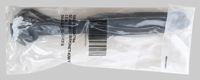  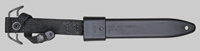  |
Imperial Schrade Corp. | Imperial Schrade Corp. of Ellenville, New York, was awarded the first M10 Scabbard contract, DAAA-09-85-C-1316, in November 1985. An additional order was placed under this contract in February 1986. Cunningham reported a total of 112,400 produced by Imperial in his 1996 book. This quantity is consistent with the total amount paid under the contract, so appears correct.
Imperial Schrade Corp. was the successor to Imperial Knife Co. Hauser Products, Inc. was low-bidder for this contract, but their bid was rejected on a technicality, per the Government Accountability Office (GAO). Imperial Knife Co. changed its corporate name to Imperial Schrade Corp. in 1984. Imperial Schrade’s M10 scabbard contract appears to be their last U.S. government prime contract. Imperial’s losing out in the M9 bayonet competition resulted in closure of the Providence, RI, plant in 1987. Imperial Schrade continued operations in Ellenville, NY, until its closure in 2004 after 100 years of operation. The company trademarks were purchased by investors, who still use the Imperial and Schrade branding on knives made in China. |
Scabbard:
"M10" and "19204 ASSY 8448476" over "MFG 74846" Label: 1095-00-223-7164 |
|||||||
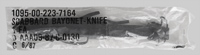   |
Hauser Products Inc. | Hauser Products Inc. of Chicago, IL, was a plastics molding firm that operated in the Chicago, IL, area from 1946–2000.
Hauser Products was awarded contract, DAAA09-87-C-0130, in October 1986. Cunningham reported a total of 33,500 produced by Hauser in his 1996 book. This quantity is consistent with the total amount paid under the contract. In 1998, Hauser Products produced M10 Scabbards as a subcontractor for Lan‑Cay Inc. under contract DAAE20-98-P-0221. According to M7 Bayonet specialist William Humes, 10,700 scabbards were produced under this contract. This quantity is consistent with the total amount paid under the contract. |
Scabbard:
"M10" and "19204 ASSY 8448476" over "MFG 1Z803" Label: 1095-00-223-7164 |
|||||||
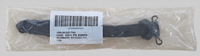  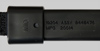 |
General Cutlery Inc. | General Cutlery Co. of Fremont, Ohio, was awarded its first M10 Scabbard contract, DAAE20-96-C-0224, in May 1996.
General Cutlery had three subsequent sole source purchase order contracts during fiscal years 2000 and 2002, none of which were reported to the National Archives, suggesting that these were likely small contracts under $25,000 each. The number of scabbards produced under General Cutlery's three contracts is not known. General Cutlery is also associated with M10 Scabbards supplied with their 1991 Australian M7 bayonet production; with the Lan‑Cay M7 Bayonet/M10 Scabbard combo; and, with a variety of M10 Scabbards produced commercially. The package pictured at left lacks a government contract number, so it is difficult to say whether it is from a government contract or just a commercial piece. Evidence suggests that Hauser Products may have manufactured all of the scabbards associated with General Cutlery Co., including government contract scabbards bearing General Cutlery Co's. CAGE Code. As shown in this comparison image, scabbards bearing Hauser's and General Cutlery Co's CAGE Codes both have the markings recessed below the surface in a similar font. (Scabbards by Imperial and Ontario have raised markings and use a different font.) |
Scabbard: "M10" and "19204 ASSY 8448476" over "MFG 20014"
Label: 1095-00-223-7164 |
|||||||
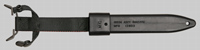   |
Lan-Cay Inc.
Red Thread M10 Scabbard |
Rare “red-thread” M10 scabbard, with a single red thread running along the left side of the black nylon belt hanger.
Lan-Cay Inc. of Carrolton, Kentucky, was awarded contract, DAAE20-98-P-0221, in April 1998. 10,700 scabbards are believed produced under this contract. The scabbards were produced by Hauser Products Inc. and bear their CAGE Code. However, the package label with Lan-Cay's contract number bears the General Cutlery CAGE Code. This suggests that Lan-Cay may have subcontracted to General Cutlery, who then retained Hauser to do the work. The red-thread scabbards came from this production run, as an example in sealed packaging, labeled as indicated above, was discovered ca. 2000. In all likelihood, the red thread was an end-of-roll warning intended to prompt the sewing machine operator fabricating and attaching the strap assembly to stop production and replenish the spool of nylon webbing. It is unknown how many had the red thread or why government inspectors accepted these. |
Scabbard (throat): "M10"
Scabbard (body): "19204 ASSY 8448476" over "MFG 1Z803" |
|||||||
|
Lan-Cay Inc. was awarded contract, W52H09-06-C-0002, in November 2005. The M10 Scabbard was a component packaged along with M7 Bayonets produced by General Cutlery Inc. Approximately 12,000 are believed to have been produced under this contract.
The scabbards were likely produced by Hauser Products Inc., however, bear General Cutlery's CAGE Code. The outer carton label with Lan-Cay's contract number bears the General Cutlery CAGE Code, as do the printed labels on both the bayonet and scabbard wrappers. This suggests that Lan-Cay may have subcontracted to General Cutlery, who assembled the bayonets but retained Hauser to make the scabbards. |
Carton Label:
"1095-00-017-9701 Scabbard Package: "1005-00-073-9238 |
||||||||
   |
Ontario Knife Co. | Ontario Knife Co. of Franklinville, New York, was awarded six prime contracts between 1987–2011 that included M10 scabbards.
Procurements resumed in 2018 via a set-aside program benefitting service-disabled veteran-owned small businesses. These procurements stipulate that Ontario Knife Co. be the supplier. The “prime contractor” is simply a middleman who profits from the transaction. To date, there have been three M10 contracts involving middlemen, for whom Ontario has been the supplier. |
Scabbard Body (front): "M10" and "ASSY 8448476" over "MFG 2V376" | |||||||
|
Ontario Knife Co. of Franklinville, New York, was awarded its first M10 Scabbard contract, DAAA-09-88-C-0129, in November 1987. The M10 Scabbard was a component packaged along with M7 Bayonets also made by Ontario. Cunningham reported a total of 58,100 in his 1996 book. This quantity is consistent with the total amount paid under the contract, so appears correct. | Label:
1005-00-017-9701 |
||||||||
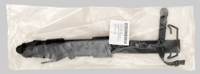 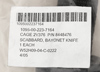 |
Ontario was awarded contract W52H09-04-C-0222 on September 4, 2004. This contract was for M7 bayonets and M10 scabbards packaged separately. | Label:
1095-00-223-7164 |
||||||||
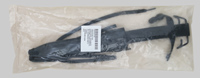  |
The example pictured at left is from contract W52H09-08-D-0004, a five-year contract awarded to Ontario in October 2007. Three delivery orders were placed for the M10 scabbard, totaling $42,469. The third delivery order was placed on May 25, 2010, for 3,000 scabbards in the amount $18,540. This suggests that the total quantity procured under this contract was approximately 6,900. The example pictured at left is one of 3,000 supplied under the third delivery order. | Label:
1095-00-223-7164 |
||||||||
| This example is from the one of the Middleman contracts.
Contract SPE7L3-19-P-7158 was awarded to Harris Support Services LLC of Mosley, Virginia, in July 2019. This contract was for 9,960 M10 Scabbards. The packaging from these contracts have two labels, one bearing the middleman’s CAGE Code and the other Ontario’s. The bayonets and scabbards, themselves, are marked like all other Ontario examples. |
Labels:
1095-00-223-7164 1095-22-223-7164 Scabbard Body (front): "M10" and "ASSY 8448476" over "MFG 2V376" |
|||||||||
| Other Bayonets with M4-M7 Series Features | ||||||||||
| U.S. M4 Bayonets and Foreign Copies | ||||||||||
| Top | ||||||||||
| © Ralph E. Cobb 2011 All Rights Reserved | ||||||||||